At Melania Trump's UN Briefing on Children, Silence on Iranian School Strikes - PassBlue
At Melania Trump's UN Briefing on Children, Silence on Iranian School Strikes - PassBlue

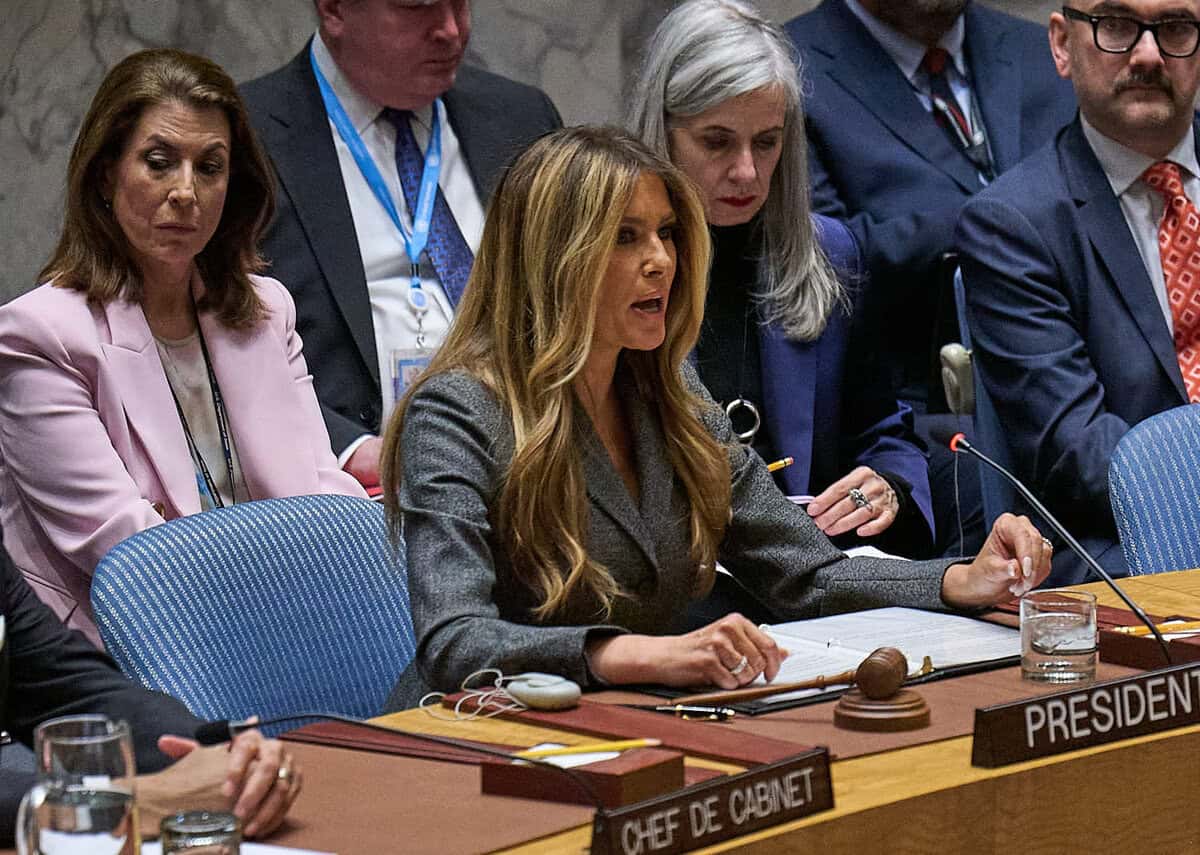
On March 2, as Melania Trump chaired the Security Council for the first time as a sitting US first lady, members focused on the topic of “children, technology and education in conflict.” But no country in the Council spoke about the deadly strikes that have occurred against schools in Iran amid the US and Israel attacks that began on Feb. 28, 2026. JOHN PENNEY/PASSBLUE
United States First Lady Melania Trump presided over a United Nations Security Council meeting on Monday to talk about the impact of conflict on children, barely two days after schools were hit and children were killed amid the US-Israeli attacks in Iran.
The first lady chaired the Council meeting as the US began its rotating presidency in March. She led the debate on the topic of “Children, technology, and education in conflict,” under the “maintenance of international peace and security” agenda item.
“The path to peace depends on us taking responsibility to empower our children through education and technology,” Melania Trump told the Council on March 2. “Conflict arises from ignorance, knowledge creates understanding, replacing fear with peace and unity.”
While her speech addressed how conflict affects children, she did not specify a particular war. She also delved into the potential benefits of artificial intelligence in educating children, while avoiding mention of reports of Iranian children killed in their schools on Feb. 28 as the US-Israeli assaults started to pummel Iran. In an emergency Security Council session later that day, UN Secretary-General António Guterres said “at least” 85 people and many more were injured at a primary girls’ school in Minab. (The number of dead has since been revised upward.)
“At a time when the US is triggering foreign wars, disinvesting from myriad UN organizations and rejecting Sustainable Development Goals that focus on climate change and gender equality,” said Taina Bien-Aimé, executive director of the Coalition Against Trafficking in Women, “it is incongruous for the first lady to express concern for children, when their very survival is tied to peace and security.”
The US leads the Council this month, but it has not held a media briefing to anounce its program of work, as is typically done at the start of each rotating presidency. PassBlue has seen a copy of the provisional agenda, which includes a special debate scheduled for March 5 on “energy, critical minerals and security” and a meeting on Afghanistan on March 9. For about 14 days of the month, there are no Council meetings planned.
(An emotional but precise description by a UN staffer on the preparations of the Council session led by Melania Trump and the strike on the Minab schoolgirls.)
Avoiding condemnation
Like the first lady, most members in the Council on March 2 focused on the risk and benefits of the use of AI in education. None of the ambassadors directly condemned the strikes on schools in Iran since the war began last Saturday, except for the representative of Bahrain, Jamal Faris Al Rowaie. He said that Iranian retaliatory attacks have caused schools in his country to be closed.
The European countries in the Council — Britain, Denmark, France, Greece and Latvia — spoke mostly on the effect of Russia’s war on Ukrainian children. African countries — the Democratic Republic of the Congo, Liberia and Somalia — talked about how conflict is affecting children on their continent. Russia and China, two permanent Council members that have directly condemned the US-Israeli attack on Iran, left the Iranian children killed in the assault out of their respective speeches on Monday.
The Iranian envoy to the UN, Amir-Saeid Iravani, speaking to journalists before the Council meeting, condemned the attack on schools in his country and other civilian infrastructure. “Protecting children and maintaining international peace and security clearly means something different from what the UN charter provides,” Iravani said.
The intensifying violence in the region since the US-Israeli bombardment started early on Feb. 28, triggering Iranian retaliation, has caused schools to be closed in several countries caught in the Iranian missile and drone fire. Apart from Bahrain, authorities in the United Arab Emirates, Qatar and Kuwait have shifted to remote learning for schools and universities as Iran continues to hit US military bases and other targets in the countries. Debris falling from intercepted drones and missiles has damaged residential buildings and civilian infrastructure in Abu Dhabi and Dubai, in the UAE.
The Central Board of Secondary Education (CBSE), an Indian school-examination authority, postponed tests scheduled for March 2 in Bahrain, Iran, Kuwait, Oman, Qatar, Saudi Arabia and the UAE because of the military strikes in the region.
Unicef’s warning
“This weekend’s military escalation in the Middle East marks a dangerous moment for millions of children in the region,” Unicef said in a statement released on Feb 28. Unesco said about 150 people were killed and 100 more wounded in the strikes that destroyed the girls’ school in Minab, southern Iran. The agency said many students are believed to be among the dead.
Stéphane Dujarric, the spokesperson for Guterres, said the potential impact that the war now being fought across numerous frontlines in the Mideast could be gleaned by looking at the effects of conflict currently on kids in Gaza, Afghanistan and Sudan.
“Now this could have an impact of just a few days and things would get back to normal. This could last longer. We don’t know,” Dujarric said on March 2. “How can children be expected to learn in an open conflict, where refugee camps are being droned, when people are being killed? It’s shameful.”
Iran said that its retaliatory attacks since Feb. 28 that have damaged civilian infrastructure are done in defense of its territorial integrity as the US-Israeli bombings increase. Neither the US nor Israel has acknowledged or accepted responsibility for the schools that were struck in Minab and another in Tehran.
“I have seen different reports,” Danny Danon, Israel’s envoy to the UN, told reporters on March 2, before the Security Council met. “Some reports say it’s actually an IRGC attack that targeted this school. I don’t have the exact information, but I can tell you that we regret the loss of life of any civilian.” He was referring to the Islamic Revolutionary Guard Corps, Iran’s elite forces.
The first lady’s presiding over the Security Council was tied to her initiative “Fostering the Future Together,” which seeks to assemble a coalition of countries meant to improve children’s well-being through education, innovation and technology. The program also calls for partnerships with the corporate world to broaden access to such educational tools as artificial intelligence, robotics and blockchain technologies.
But not every Council member bought the premise of AI’s full gift to the world. “The digital space does not come risk free,” Christina Markus Lassen, Denmark’s ambassador to the UN, said. “Young women and girls may be targeted by technology-facilitated gender-based violence.” Tech companies, she added, have a “great responsibility to protect children’s rights.”
Damilola Banjo is an award-winning staff reporter for PassBlue who has covered a wide range of topics, from Africa-centered stories to gender equality to UN peacekeeping and US-UN relations. She also oversees all video production for PassBlue. She was a Dag Hammarskjold fellow in 2023 and a Pulitzer Center postgraduate fellow in 2021. She was part of the BBC Africa team that produced the Emmy-nominated documentary, “Sex for Grades.” In addition, she worked for WFAE, an NPR affiliate in Charlotte, N.C. Banjo has a master’s of science degree from the Columbia University Graduate School of Journalism and an undergraduate degree from the University of Ibadan in Nigeria.
Comments (0)
No comments yet. Be the first to share your thoughts.
Sign in to leave a comment.