Central Asia Roundup: February 2026 - New Lines Institute
In February, Kazakhstan and Uzbekistan participated in the inaugural meeting of the Board of Peace, Kazakhstan prepared for a constitutional referendum, EU envoys discussed sanctions with Kyrgyzstan, and Central Asia and the United Kingdom a new diplomatic format. The inaugural meeting of the Board of Peace in Washington was an opportunity for representatives of over […]

Central Asia Roundup: February 2026
In February, Kazakhstan and Uzbekistan participated in the inaugural meeting of the Board of Peace, Kazakhstan prepared for a constitutional referendum, EU envoys discussed sanctions with Kyrgyzstan, and Central Asia and the United Kingdom a new diplomatic format.
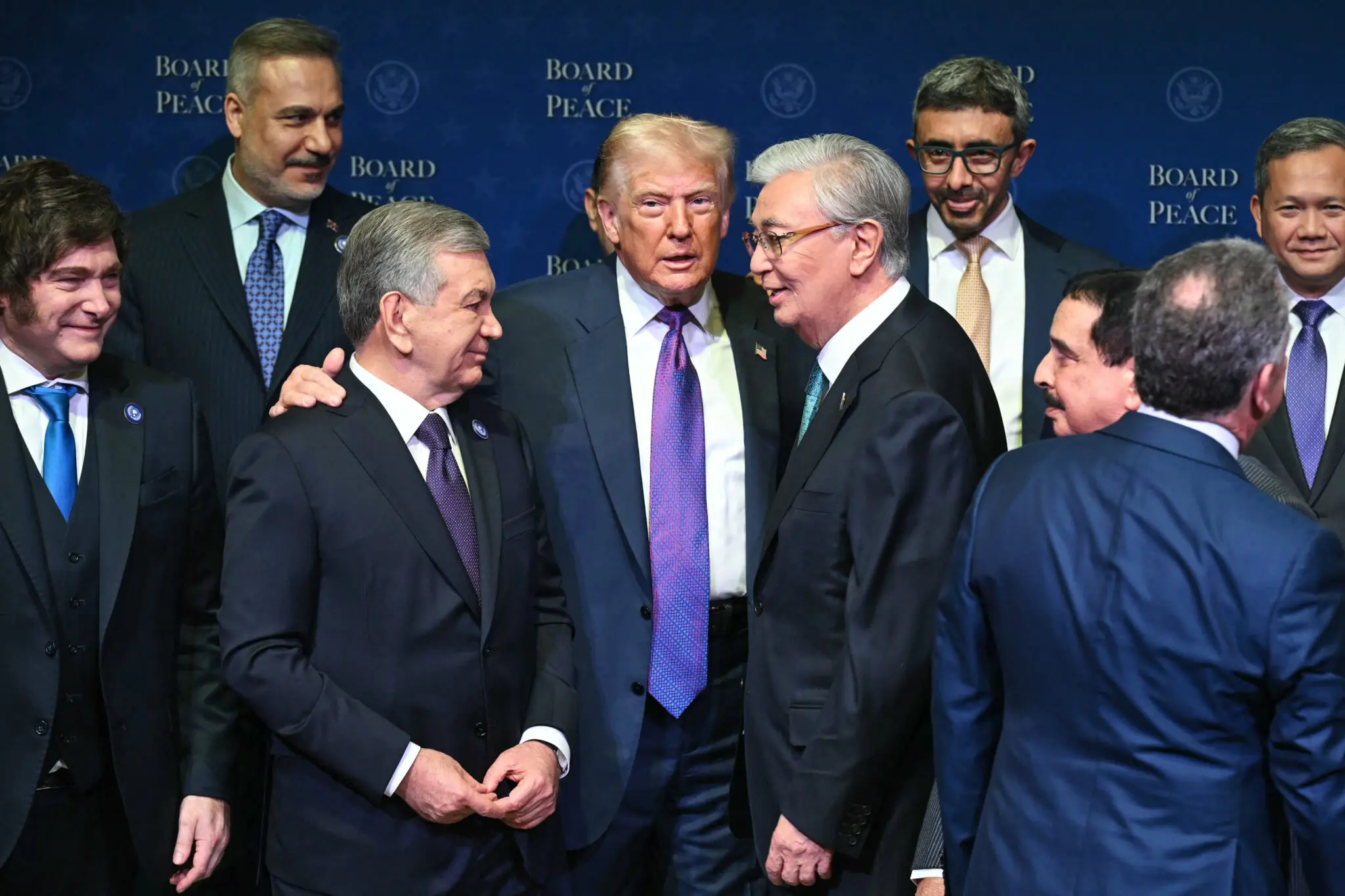
The inaugural meeting of the Board of Peace in Washington was an opportunity for representatives of over 40 countries, including its 26 founding members, to meet. Among them were the presidents of Kazakhstan and Uzbekistan, Central Asia’s two largest economies, who pledged $7 billion for Gaza. The participation of these economies in this U.S.-led peace initiative signals their openness to further engage economically and diplomatically with the United States while leveraging these initiatives to advance bilateral and trade agreements.
Kazakhstan
Kazakhstan is preparing for a March 15 referendum over whether to adopt a completely revised constitution, which President Kassym-Jomart Tokayev says will better reflect the country’s economic, geopolitical, and technological status. Among the proposed changes are moving to a unicameral legislative body from a bicameral one, limiting the president to one seven-year term, and introducing a People’s Council with powers to initiate legislation and hold referendums.
Another aspect of the draft constitution concerns the Russian language, which the current constitution defines as being “on equal footing” with Kazakh. The draft revises its status as an official language to “go along with” a proposed change that raises questions about the status of ethnic Russians, who make up a significant portion of Kazakhstan’s population. The constitutional revision process has been criticized for being rushed, with the completed draft constitution being made public a month before the planned referendum.
At the international level, Tokayev participated in the inaugural meeting of the Board of Peace in Washington on Feb. 19, underscoring Kazakhstan’s role as a constructive middle power. Its national mining company, Tau-Ken Samruk, cooperated with U.S. Cove Capital in November 2025 on a $1.1 billion joint agreement to develop untapped tungsten deposits in the Karaganda region. This example of U.S.-Kazakh economic cooperation illustrates that Kazakhstan’s critical minerals diplomacy is becoming an increasingly important component of the global race for critical minerals.
Meanwhile, talks about a planned visit by Russian President Vladimir Putin to Kazakhstan continue following Tokayev’s visit to Russia in November 2025. In that meeting, Tokayev and Putin elevated bilateral ties by signing a declaration on a “comprehensive strategic partnership and alliance” that is focused on cooperation across trade, energy, and security sectors. The ability of Kazakhstan to deepen its relationships with both Washington and Moscow at the same time reflects its multifaceted foreign policy strategy, though the constitutional referendum and language debate could challenge its ability to balance Russian interests with the public’s demands for agency and a stronger Kazakh identity.
Uzbekistan
President Shavkat Mirziyoyev also traveled to Washington on Feb. 19 for the Board of Peace meeting, his second visit to the White House in less than four months. The participation of Uzbekistan in the Board of Peace is part of its strategy of using diplomacy to advance its economic objectives. Uzbekistan is eager to obtain U.S. capital guarantees for infrastructure as part of the Trump Route for International Peace and Prosperity (TRIPP) and the Trans-Caspian International Transport Route (TITR), which link East Asia to Europe. Because Uzbekistan is one of only two double-landlocked countries in the world, access to these routes is an economic necessity.
In his address to the Board of Peace, Mirziyoyev stressed Uzbekistan’s commitment to a practical role in its implementation, framing its participation as consistent with the country’s foreign policy priorities of supporting multilateral peace initiatives. Uzbekistan’s participation elevates its international standing from a regional mediator to a contributor to global peace and security frameworks, which is a significant reputational gain for a country that has been largely isolated internationally.
Domestically, Mirziyoyev continued to emphasize his results-oriented approach to foreign policy. In the first part of the year, key performance indicators were issued to the country’s ambassadors, measured by export and tourist volumes, and support for Uzbek labor migrants. The president also issued national goals to increase exports to $40 billion and attract $50 billion in investments.
Kyrgyzstan
February was a month of dramatic changes in the country. President Sadyr Japarov removed longtime ally and security chief Kamchybek Taskiev and several associates from key positions in government, a landmark change in the country’s political dynamics.
Diplomatic pressure on Kyrgyzstan intensified in February, as mounting evidence suggests that Kyrgyzstan is shipping machine tool and radio equipment to Russia as a way for Moscow to circumvent EU sanctions. EU sanctions envoy David O’Sullivan held a series of meetings in Kyrgyzstan on Feb. 26, including ones with central bank and economic ministry officials, as the EU prepares to adopt a large package of sanctions targeting Russia. The draft package includes a plan to impose a ban on exports of CNC machines and radio equipment to Kyrgyzstan in light of EU data showing that EU exports of those items to Kyrgyzstan grew by almost 800% in the first 10 months of 2025 compared with prior the Russian invasion to Ukraine , while Kyrgyzstan’s exports of the same goods to Russia grew by 1,200%.
O’Sullivan said the EU would not require Kyrgyzstan to adopt EU sanctions or halt trade with Russia but that the “deliberate re-export” of sanctioned goods via Kyrgyzstan is simply “unacceptable.” He added that there are also issues regarding the penetration of Kyrgyzstan’s banks and cryptocurrency exchanges by actors that want to evade sanctions, and that a draft of the EU’s sanctions package includes adding a Kyrgyzstan-based crypto company to the EU’s blacklist for serving Russian financial interests.
Kyrgyzstan would become the first Central Asian nation to be sanctioned by the EU, but the decision will be complex. All member states must agree on these proposed sanctions, but countries such as Germany, Italy, and Poland are the largest exporters of these products to Kyrgyzstan.
Tajikistan
Developments in Tajikistan in February were characterized by sustained economic growth and ongoing issues of governance. Foreign investment in Tajikistan was $6.93 billion in 2025, a 35% increase over the preceding year, with investments from countries in the Commonwealth of Independent States (CIS) increasing by 54.4% and investments from non-CIS countries increasing by 23.1%. The country’s GDP growth of approximately 8.2% in 2025, with projected growth of 8.55% in 2026, suggesting an optimistic economic future, although data from the International Monetary Fund and World Bank show that many of the country’s economic developments remain reliant on remittances and external funding.
The Tajik government said it plans to allocate more than $1 billion of its 2026 budget to finance the Rogun hydropower dam despite issues of auditing and finance indicated in January. In context, this is 15% of the country’s budget to finance the dam – signaling an enormous commitment for the country’s size and national income level.
The World Bank indicated continued commitment to Tajikistan with the development of a new Country Partnership Framework (CPF) for 2026-2031, focusing on energy production, power grid development, and climate change adaptation and mitigation.
Tajikistan’s foreign relations in February involved multilateral meetings of the Central Asia-Germany and Central Asia-U.K. frameworks, as well as ongoing discussions with Pakistan on the Uzbek Afghan-Pakistani Railway Corridor. Like Kyrgyzstan and Turkmenistan, Tajikistan was not invited to the Board of Peace, indicating a division between the higher diplomatic profiles of Kazakhstan and Uzbekistan. This reflects a structural divergence in how two economies are engaging and operating on the global diplomatic stage while other economies are constrained by economic dependency, sanctions, and limited institutional capacity. Such a risk becomes a reality especially if Western governments concentrate their efforts on Kazakhstan and Uzbekistan, leaving the smaller economies to further depend on Russian and Chinese influence.
Turkmenistan
Turkmenistan cautiously engaged with other countries in two new formats. At the inaugural ministerial meeting of Central Asia-U.K. framework, Turkmen Foreign Minister Rashid Meredov highlighted key areas for cooperation with the United Kingdom, including energy and transportation. Turkmenistan is particularly interested in attracting British investments in the field of infrastructure and the energy sector, and the development of cooperation in the fields of green finance, banking services, digital technologies, and insurance services. The two countries also signed memorandums of cooperation in education and culture.
Turkmenistan accredited its permanent representative to the International Renewable Energy Agency (IRENA), in line with its ambitions to develop its exports of energy products, including but not limited to natural gas. The country also has announced plans to develop a National Strategy for Scientific and Medical Diplomacy until 2052, a long-term plan in line with the style of governance in Turkmenistan.
Regional Implications
Central Asia is seeing a growing divide in international engagement. While Kazakhstan and Uzbekistan are in a global stage where they participate in the Board of Peace meeting, sign trade agreements with the United States, and assert themselves as middle powers capable of making a positive contribution in unstable regions in the world outside their own region. Kyrgyzstan is struggling with sanctions from both the EU, while Tajikistan and Turkmenistan feature in multilateral frameworks and economic cooperation arrangements.
The engagement of both Kazakhstan and Uzbekistan in the Board of Peace summit is a critical moment for Central Asian states because it provides them with a chance for connection in a global initiative led by the United States. The calculation is simple for Kazakhstan and Uzbekistan: Having access to Trump also means having access to trade agreements, investments, and a potential path away from Russian and Chinese influence
The escalation of the EU’s measures against Kyrgyzstan, progressing from the imposition of restrictions on individual entities to the discussion of a ban on exports, is creating a precedent in the region. Should the EU sanctions become a reality, the other countries in the region will take this into account.
Creating new multilateral formats speaks to the European powers’ desire to develop stronger ties with the region, potentially providing the Central Asian countries with a way out in the context of international relations. For Turkmenistan, this is particularly important, as it would allow the country to develop ties with the EU without the institutional commitment that its neutrality policy requires. Multilateral foreign policy is not just a diplomatic game; it is a matter of survival in a region of comparatively small countries that are forced to compete in an increasingly challenging geopolitical arena.
Footnotes
Comments (0)
No comments yet. Be the first to share your thoughts.
Sign in to leave a comment.