Europe can lead its conventional defense 'by 2035', EUCOM commander says
The date could signal a turning point in America’s relationship with the NATO alliance.

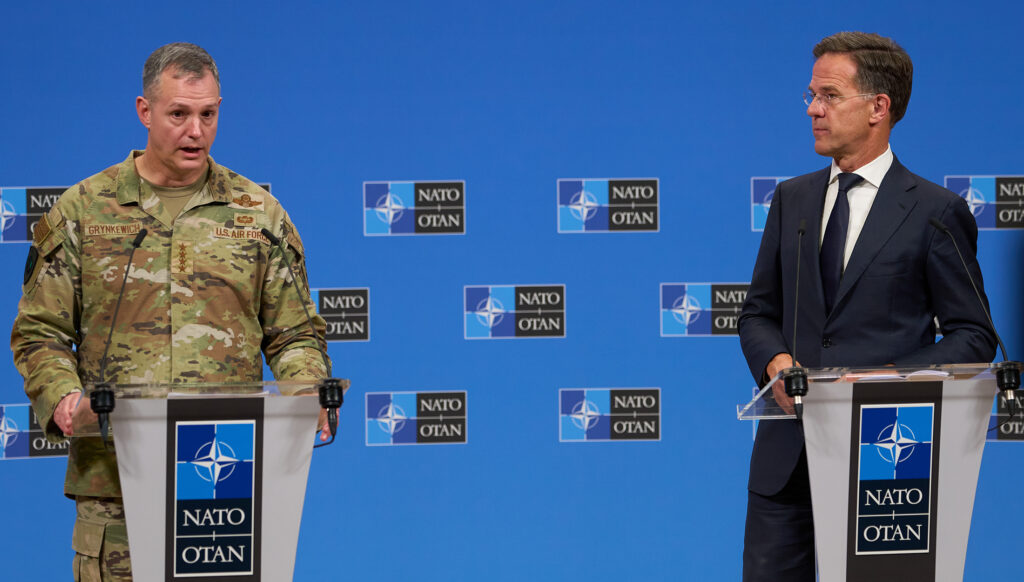
WASHINGTON — Efforts to ramp up military spending in Europe should culminate in the continent being able to take the lead role in defending itself in roughly a decade, America’s top military commander in the region said today.
In testimony before the Senate Armed Services Committee, Air Force Gen. Alexus Grynkewich, the commander of US European Command (EUCOM) and NATO’s supreme allied commander of Europe, said a handful of nations are near or have already met an alliance-wide target to spend 5 percent of their GDP on defense. And as more countries increase their expenditures on military equipment, the general noted it will take some time for the indigenous industrial base to catch up.
“So I would say by the end of this decade, they will have made great progress toward that,” Grynkewich said in response to a question from Missouri Republican Sen. Roger Wicker, who asked how long it will take for “our European friends” to “build the capabilities and force structure needed to actually assume the lead role in the conventional defense of Europe.”
As long as European countries remain on the path of increasing spending in line with NATO targets, Grynkewich noted, they “won’t be all the way there,” by 2030, “but certainly by 2035 they will be.”
RELATED: Europe leads global arms imports market as demand surges: SIPRI report
The date could mark a key inflection point for America’s relationship with NATO, where the US has maintained the lead in both conventional and nuclear deterrence since the formation of the alliance in 1949. The shift comes amid a strategy by the Trump administration to cajole European allies to spend more on their collective defense so that America can shrink its footprint on the continent and free up resources for other theaters like the Indo-Pacific.
The approach has not come without controversy. In remarks today, Wicker, SASC chairman, rejected a vision to draw down US forces in Europe dubbed by some in Trump administration as “NATO 3.0.” Such a step “would have us take an unnecessary vulnerability on at a precarious moment” as Russia’s invasion of Ukraine enters its fifth year, Wicker said. That’s why, he continued, his committee placed a “floor on the US military’s force posture in Europe.”
According to Grynkewich, the US military’s force posture on the continent has only changed by withdrawing one brigade combat team at the end of last year — an apparent reference to a removal of troops from Romania that some American officials said blindsided Bucharest.
Faced with the specter of further Russian aggression, many European leaders have endorsed rearmament, though wariness about US commitment to the region lingers. Countries like France, for instance, have discussed assuming a leading role in European nuclear deterrence, though the topic was not broached during the committee hearing today.
Separately, Grynkewich said an ongoing plan to revise NATO’s “standing defense plan for integrated air and missile defense” should be completed this summer. It’s the first rewrite of the plan “in decades,” the general said.
TRANSCOM At War
Testifying beside Grynkewich today, Air Force Gen. Randall Reed, the Commander of US Transportation Command, fielded several questions about the impact of the US and Israel’s ongoing war against Iran, an operation whose tempo is closely dependent on mobility forces.
As concerns center around the closing of the Strait of Hormuz due to Iranian attacks, Reed acknowledged in an exchange with Arizona Democratic Sen. Mark Kelly that recent damage to a vessel covered by the Maritime Administration’s Tanker Security Program — one of just 10 — can have an outsized impact due to the small size of the fleet. The tanker, dubbed the Stena Imperative, was hit on March 2 in a Bahraini port. (USNI News reported the ship was previously chartered by Military Sealift Command but is not currently under contract.)
In a separate line of questioning from Michigan Democratic Sen. Gary Peters, Reed said there have been “disruptions” to the flow of commercial traffic, which TRANSCOM relies on heavily to move supplies. But, he added, firms “are able to deliver to points that are safe.” After that, Reed said TRANSCOM can handle the rest. Additionally, he noted there are “alternatives” to moving shipments through the embattled Strait.
In spite of the conflict that poses perils for commercial carriers, “We can absolutely rely on them,” Reed said. Notably, though the war has led to a surging demand for air defenses — including the movement of part of a THAAD air defense battery from South Korea to the Middle East — Grynkewich said he has not been asked to relocate any air defense systems from Europe for a similar purpose.
Comments (0)
No comments yet. Be the first to share your thoughts.
Sign in to leave a comment.