ICE enforcement nationwide shaped Virginia immigration bills in real time - VPM.org
Virginia lawmakers introduced bills to restrict federal immigration enforcement in response to rising ICE activity and incidents of enforcement in the state, including increased use of 287(g) agreements. The expansion of these agreements has led to concerns over local law enforcement powers and community trust, with legislation being proposed to limit cooperation with ICE and prevent enforcement near polling stations. The debate reflects a broader concern about state control over immigration enforcement and the impact on public safety and community confidence.

As the 2026 General Assembly session began, state Sen. Saddam Azlan Salim (D–Fairfax) introduced bills to put restrictions on federal immigration enforcement in Virginia, framing them as a response to the growing fear in immigrant communities.
At the time, it appeared that Virginia's Democratic leadership wasn't all-in on protections for immigrants. When asked what legislation Virginia Democrats would introduce, House Speaker Don Scott (D–Portsmouth) demurred.
"I'm not sure about that right now. The voters told us what they wanted us to focus on, and that is what we are focusing on," he said on Jan. 14, referring to lowering costs. "These other issues will come up. Obviously, we want to make sure that we do everything that we can to protect all Virginians, all vulnerable Virginians, all marginalized communities. We're going to have some conversations about that as well."
And Gov. Abigail Spanberger issued an executive order on her first day in office that stopped short of ending Virginia law enforcement agencies' cooperation with US Immigration and Customs Enforcement.
But as the weeks unfolded, events hundreds of miles away would sharpen Scott's argument — and the urgency inside the Virginia State Capitol.
In Minnesota, a large-scale federal immigration enforcement effort drew national attention after confrontations between agents and residents escalated quickly into mass protests and the shooting deaths of Renée Good and Alex Pretti. The deaths of Good and Pretti and detainments of demonstrators fueled scrutiny of enforcement tactics and state-federal cooperation, and Virginia legislators invoked both during floor sessions.
"I think that's when the shift in all of this, at least with the legislative side in Virginia, from 'this was a minority group,' now it's actually the minorities and the majorities," Salim said. "Actually, 100% of everyone could be at risk of all this."

ICE surge sparks response
Long before the General Assembly push, immigration enforcement was visibly rising in Virginia with the assistance of local law enforcement and advocates warned about its effects.
About a month after Donald Trump was sworn in as president for a second time, then-Gov. Glenn Youngkin signed Executive Order 47, directing Virginia State Police and other state offices and law enforcement agencies to cooperate with federal immigration enforcement by entering into 287(g) agreements with ICE. The 287(g) program deputizes state and local law enforcement officers to carry out federal immigration enforcement functions under ICE supervision.
As a result, ICE arrests surged in 2025 with nearly 7,000 arrests reported between January and mid-October — nearly seven times 2024's arrests for that time frame. During the summer, immigration enforcement was rampant, with agents detaining individuals inside and outside courthouses, in predominantly Latino neighborhoods, and as their children waited for the school bus.
"I have introduced three bills in the Virginia Senate to keep the chaos, lawlessness, and violence that we have seen perpetrated against Minnesotans from coming to Virginia," Salim announced on Jan. 26.
His bills focused on protecting people attending required court hearings, prohibiting law enforcement officers from wearing face coverings (with limited exceptions) and placing restrictions on which members of law enforcement can "perform a function of an immigration officer."
On the other side of the Capitol, House delegates introduced legislation mirroring Salim's — and another that would have barred immigration enforcement close to polling stations.
"What we have seen from ICE agents is intimidation," said Del. Alfonso Lopez (D–Arlington). "Virginians should never be intimidated, silenced or targeted when they show up to vote."
But despite calling a press conference on Jan. 28 to discuss immigration legislation, the assembled Democrats sidestepped questions from press about the bills.
"We're going to talk about all the bills in committee," said Del. Marcus Simon (D–Fairfax) about a bill limiting ICE cooperation.
Salim said his legislation ultimately became about more than immigration status. After seeing courthouse arrests and a rise in 287(g) agreements — and having a member of his own family detained by ICE — he said he came to see the issue as one of broader civic trust.
"We're doing the right thing by making sure that there's checks and balances within the cooperation that we have with federal agents," Salim said.
The rise of 287(g) agreements in Virginia
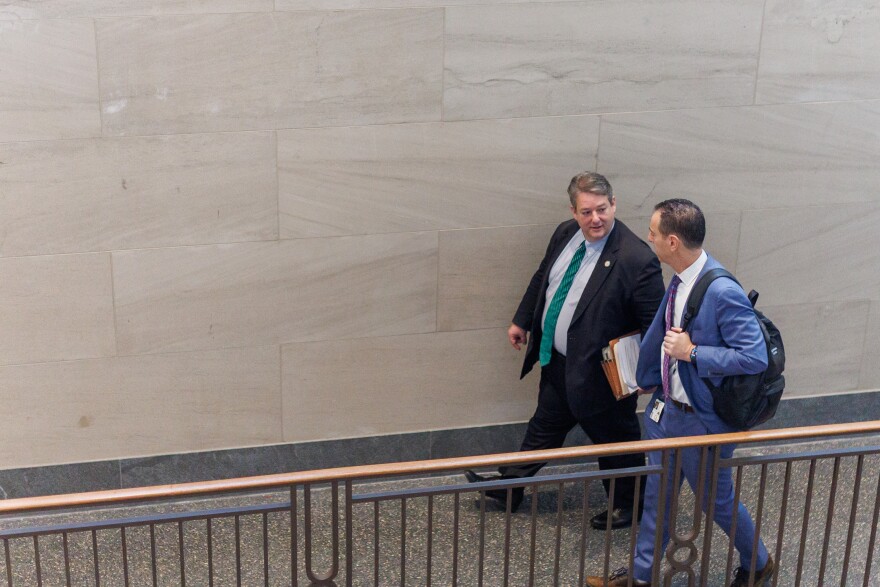
Virginia's participation in the federal 287(g) immigration enforcement program expanded rapidly after Youngkin's executive order, with 28 agreements still active as of Feb. 20 of this year.
Prior to 2025, the state went years without any active 287(g) agreements, following the Prince William–Manassas Regional Jail Board's decision in 2020 to end its decades-long partnership with ICE.
And while Spanberger later signed a separate directive instructing all state law enforcement agencies to terminate their 287(g) agreements, that directive has no effect on localities that have entered into such agreements.
Legal Aid Justice Center is supporting legislation calling for the end of all 287(g) agreements in Virginia.
"287(g) is just the most visible and currently most lucrative form of cooperation or entanglement between law enforcement, local law enforcement and ICE," LAJC's director of litigation, Alex Kornya, told VPM News.
Beyond the cooperation itself, Kornya said, these agreements empower local law enforcement to go out on their own and start exercising many of the same powers that ICE wields, with "potentially very little direct supervision or direction" from the agency.
An investigation by LAJC found that as of December 2025, at least 223 state and local personnel had been nominated to act as immigration enforcement, with around 157 being certified. Records show that in Washington County, in Southwest Virginia, a school security officer and a behavioral health advocate have the power to carry out immigration enforcement functions.
To participate in these agreements, officers must complete a 40-hour online course and achieve a score of 70% or higher to pass.
Kornya said that task force model agreements — which make up most of Virginia's 287(g) agreements — are of particular concern, as officers perform immigration enforcement during routine policing.
"They're interacting with people in a variety of different ways, traffic stops, potentially other types of encounters out in the community," Kornya said. "It's more than just sharing information. It's more than just working together with ICE. They become quasi-independent immigration enforcement."
Compensation for 287(g) agreements has also become increasingly incentivized, with the federal Department of Homeland Security now footing the bill.
Prior to this, the work executed under 287(g) agreements was completely funded by the localities themselves, with ICE only covering upfront training and technology costs. However, last fall, DHS said funding from Trump's One Big Beautiful Bill Act would cover ICE's new reimbursement program for state and local law enforcement assisting DHS' mission to "protect the homeland."
As a result of Trump's legislation, ICE's budget has significantly increased, with the agency receiving $75 billion to spend in the next four years. DHS is currently facing a partial shutdown due to a standoff tied to immigration enforcement reforms. However, ICE continues its enforcement work under existing funding.
Reimbursement for participating state and local law enforcement agencies includes the annual salary and benefits of each eligible trained 287(g) officer, plus overtime coverage up to 25% of the officer's annual salary. Agencies are also eligible for quarterly performance grants based on the "successful location of illegal aliens."
"I think we have to ask ourselves: Are we really going to regret allowing local law enforcement to define what their own powers and priorities are outside of local concerns or outside of the constraints of the Virginia code and constitution?" Kornya asked.
Kornya said allowing local law enforcement agencies to be subsidized by federal immigration enforcement funding will dilute the kind of local control that local taxpayers typically have over their law enforcement offices.
"If you have to choose between [local concerns and federal enforcement activities], and one of them pays a lot of additional revenue, then what really happens over time is we're going to start losing control over the activities of local law enforcement," he said.
"We will fight back"
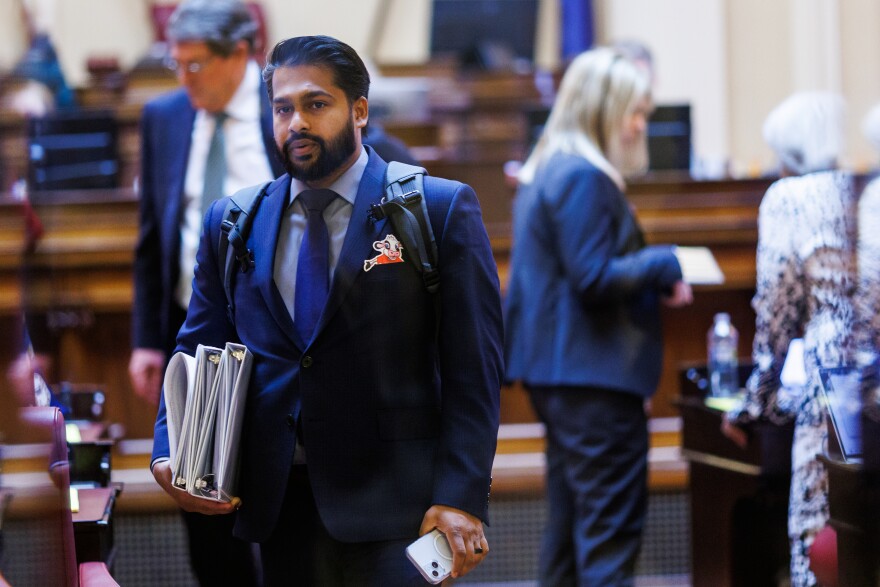
Salim argues that his bills aren't just a way to protect Virginians — regardless of status — but also to protect the trust earned by local law enforcement in communities.
"I think what it says is that we are not letting untrained federal agents, or federal agents who have not been at the job for too long, come into our law enforcement — where they've been trained very well — and taint and tarnish their reputation," Salim said. "I think this is going to say 'We're protecting our law enforcement, we're protecting our enforcement mechanism.'"
All of Salim's bills have passed out of the senate and are being considered by the House of Delegates. Salim's bill on ICE cooperation passed the Senate in a 21–19 party-line vote. House bills on limiting 287(g) agreements, barring some data sharing with immigration agencies, and prohibiting ICE close to polling places are all being considered by the Senate.
"This is really just the very same anti-law enforcement, defund the police playbook that we have been watching play out over the last five years. It's a different badge this time, but it's the exact same script," said state Sen. Glen Sturtevant (R–Colonial Heights) in debate before passage of the bill. "Make cooperation harder, second-guess decisions in real time, add in legal traps for police, and then act surprised when public safety gets worse."
Virginia Democrats were also keen to put Republicans on the record, calling for recorded votes on changes to Salim's bill that would give the Virginia State Police authority to investigate shootings involving ICE agents, require ICE agents to have judicial warrants to enter homes and make ICE agents subject to Virginia laws on the use of force.
Republicans voted for those amendments, but voted against others that would have blocked ICE from using surveillance technology or conducting immigration enforcement near polling stations.
"This is a lot more to set the standard that regardless of who is in the federal seat, who is the president, that we as Virginia should think independently and should stand up to anything that tarnishes the Virginia democracy, the Virginia way of doing business," Salim said. "We will fight back."
Copyright 2026 VPM
Comments (0)
No comments yet. Be the first to share your thoughts.
Sign in to leave a comment.