I'm A Parent In ICE-Occupied Minnesota. Here's What I Don't Tell My Children. - HuffPost
A Minneapolis father describes the impact of intensified ICE enforcement operations on his family and community, following the January 7 shooting death of Renee Good by an immigration agent and a subsequent incident in which ICE agents deployed chemical irritants outside Roosevelt High School during student dismissal. The author details the emotional toll of explaining these events to his young children, alongside broader community disruptions including school closures, declining attendance, lockdowns, and families too fearful to leave their homes. He describes neighbors organizing mutual aid, standing guard outside schools, and using encrypted communications, while noting that the trauma extends beyond immigrant families to all residents of the city. The piece concludes with a partial drawdown announcement from border czar Tom Homan, though the author expresses skepticism and calls for continued community solidarity.

On Jan. 7, three hours after dropping off my kids at school, I get a news notification that an unarmed woman had been shot and killed by an immigration agent a few miles from my house in Minneapolis. Before I can process how this might affect my city, I wonder how it will affect my fourth grader and kindergartener.
Hours after the killing of Renee Good by Jonathan Ross, it feels as if everyone is intently watching as ICE agents storm the nearby Roosevelt High School’s grounds while students are still leaving after the dismissal bell. Amid the teenagers scrambling in confusion, a special education assistant from the school is detained and taken away. Without a warning to disperse, ICE agents fire chemical weapons across the crowd of panicked students and staff.
By dinnertime, I still keep this information from our kids, because they are young, and I’ve already needed to sit down with them in the past seven months to tell them about the Annunciation Catholic school shooting and the assassination of Minnesota House Speaker Melissa Hortman and her husband. A third local, fatal catastrophe feels like too much.
So, after washing the dishes, I don’t tell my kids where I’m going when I leave to drive a few miles to join thousands of other people at a vigil for Renee Good. Later, after the kids have already gone to sleep, we learn via email that local schools are canceled for the next two days “due to safety concerns related to today’s incidents around the city.”
My wife and I sit in our kitchen debating how to explain to our kids that they can’t go to school because a woman was murdered and federal agents wrought havoc outside a high school’s door.
We look at a document titled “What To Say To Kids About ICE,” but all of the suggested phrases emphasize how this is happening to other people, people we probably don’t even know, not to the students who sit with our kids in class. The document doesn’t say anything about how to talk to your kids about how federal agents might douse them with pepper spray the next time they attend school.
My wife starts to cry. I get up to hug her, but she firmly says, “No. No. I don’t need a hug.” She wipes away tears. “I’m just so *angry *right now.”
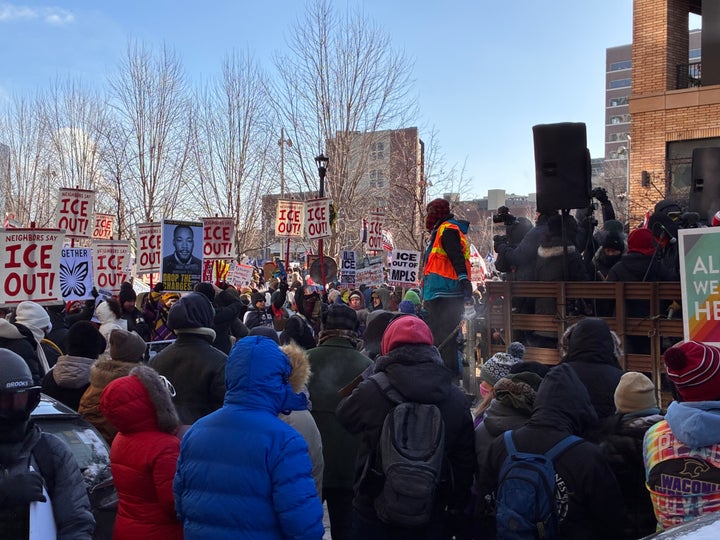
Since Operation Metro Surge began, countless immigrant families have gone into hiding, too afraid to leave their homes for work or groceries or even daylight. Like many others across the city, my friends and I gather as many groceries as we can and donate these supplies to food shelves and churches that will get them to people who are too afraid to leave their homes.
Over the weekend, our elementary school’s principal emails to say that the fourth and fifth grade teachers will likely talk to students about the specific details of the shooting and high school incident. So, even though I had hoped to only speak broadly about that awful day with our fourth grader — a girl who not so long ago debated with friends about whether Santa Claus is real — we realize that we’ll need to prepare her before she goes back to school.
I sit down and already feel like a liar because I hadn’t explained earlier. She immediately tenses up because no kid has ever heard good news after a parent said, “I need to talk to you about something.”
I stutter through an explanation about a brave woman who was trying to observe what these agents were doing. The woman had said, “I’m not mad at you.”
I pause before saying, “And then he shot her.”
My daughter somberly looks down and says, “Oh,” in a way that lets me know that she realizes she doesn’t get to be a kid anymore.
I go on to explain more — because, of course, there’s more. I explain what happened at the high school. The kids were sprayed with a “chemical irritant.” I’ve never used that phrase in my life. But it’s what the news used, so I use it, too, even though most people say “pepper spray.” But “pepper spray” sounds too nice, too much like a seasoning, so I go with “chemical irritant.”
And when I finish explaining this terrible day, my daughter looks straight ahead into a void and solemnly asks, “Did the kids die?”
“Kids her age don’t even know how things could be better. They don’t know what the adults could possibly mean when they say “normal.” To them, this is normal.”
I am on the absolute edge of completely losing it, but I’m grateful that I can say, *No, they didn’t die *— not this time, not like in the Catholic school shooting that happened 13 short blocks away from our house a few months earlier.
I tell her, “Your teachers will keep you safe.”
I tell her, “We’re always nearby. We can get there really fast.”
This seems to satisfy her enough. She can fall asleep that night. But I don’t know if her teachers can possibly keep her safe. I don’t know if I can do anything to keep her safe. We all need to believe in Santa Claus for just a little while longer.
My friend’s middle schooler tells him that between the the pandemic, the George Floyd uprising, the local politician’s assassination and the Annunciation shooting, the ICE occupation merely seems normal to her. “This is actually probably harder for the adults,” she tells him, because kids her age don’t even know how things could be better. They don’t know what the adults could possibly mean when they say “normal.” To them, this is normal.
I hope that, perhaps, my kindergartener is still young enough to come out of this mentally unscathed, and that we will still share some semblance of “normal.” But over the weekend, my wife’s co-worker drives down I-94 and passes a stopped car with four ICE agents surrounding it, pointing guns at the person inside. The co-worker’s 6-year-old son in the backseat sees them and immediately starts crying. And I realize that I have very little control over how my kindergartener will define “normal.”
Before driving anywhere, even on a quick errand, I internally debate whether to drive our nice car or our much older car in case I need to ditch it overnight. I wonder if I should bring my eyeglasses and wear a comfortable set of clothes in case I’m detained for doing something perfectly legal.
And I, by the way, am a white man in an increasingly upper-middle-class neighborhood full of doctors and lawyers and people who have had jobs at Fortune 500 companies for 20 years. My neighbors and I are fortunate people who have been thrust into an extremely unfortunate situation by a man who barely any of us voted for. But we have already weathered so many terrible events together that it doesn’t seem strange to now be speaking to each other through encrypted messaging apps to avoid government surveillance.
On massive group chats, I read never-ending messages about families in hiding, families who need supplies, families whose young U.S.-born children need to work in order to bring in any household income. I read messages about children who get off their school buses, but no parent is waiting for them at the stop because they’ve been taken during the day.
Neighbors trade tips on how to keep our schools safe. What should you bring when standing guard outside of the city’s most vulnerable schools? Parents consider wearing things like ski goggles to stop the pepper spray and teargas from getting in our eyes. We’ll probably want earplugs because the whistles are incredibly loud. We trade tips on how to snuff out a tear gas canister. We do this in between tasks for the white-collar jobs we stopped focusing on days ago.
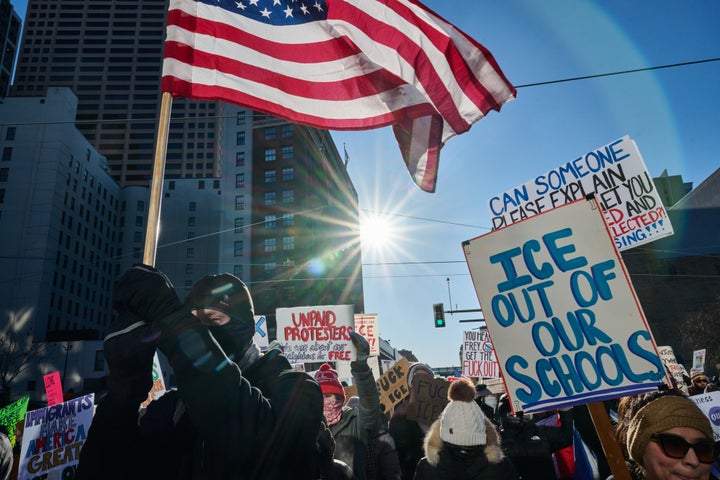
Before schools reopen on Monday, the district announces that families may choose an online learning option for the next month. They don’t specify that this is for families who fear leaving their homes during the ICE occupation, but everyone can read between the lines. School attendance has already fallen across the metro area.
While Minneapolis’ schools were closed in the days after Good was killed, half of St. Paul’s Spanish-speaking students and a quarter of its Somali students were absent. Later, several nearby schools offer an online option or go fully remote, such as a charter school in the suburb south of our home where attendance dropped to only 39%. By Jan. 13, one-fifth of all students in Minneapolis Public Schools will express interest in the online option.
My children’s school, with its relatively small immigrant population, doesn’t feel especially vulnerable to an ICE raid. Still, when we walk our kids to school on that first morning back, there is a nervous tension in the adults’ steps. When I ask other parents how they’re doing, the response is, “Well, you know,” and an awkward laugh. Dropoff and pickup, however, seem fine. Our kids seem fine. It seems normal.
But by the end of the day, I learn that a bomb threat was called in to a nearby middle school many of our friends’ kids attend. And ICE was reportedly present outside elementary schools in neighborhoods even richer and whiter than our own.
This latter point might not have previously caught me off guard. But reports of ICE’s dangerous actions have piled up in our news and social media feeds. ICE officers regularly ram into cars, drive erratically and speed through red lights and stop signs. Without warning, dozens of masked, heavily armed men will show up at a scene to capture a single person. They often leave the abductees’ cars in the road, sometimes still running, sometimes without putting them in park, allowing them to roll away without anyone in them.
When one white woman asked why she was being detained on Jan. 8, an agent barked back, “We don’t need a reason to take you.” And while carrying arsenals suited for a war zone, ICE officers regularly slip and fall on the icy sidewalks and streets. In at least one instance, an agent dropped a fully loaded magazine when he fell, not realizing he had left it behind for civilians to pick up.
“I tell my kids that I’m ‘just going for a walk’ before they leave for school. I don’t want to scare them by letting them know I’m actually going ahead of them to make sure that there aren’t masked, armed men waiting outside the school doors when they arrive.”
Now that ICE regularly drives down the major avenue near my kids’ school, I understand that any of this could easily happen not far from their classrooms the next day.
So the next morning, I tell my kids that I’m “just going for a walk” before they leave for school. I don’t want to scare them by letting them know I’m actually going ahead of them to make sure that there aren’t masked, armed men waiting outside the school doors when they arrive. Our family is white, so I do this to preserve my kids’ mental well-being, while assuming they aren’t at risk of being deported. But much more is at stake for the immigrant families whose children attend local schools. In the weeks leading up to Good’s killing, many parents had already begun escorting children in and out of the schools serving those most at risk.
I haven’t picked up a whistle yet, so I carry our kids’ recorder in case ICE shows up near our school. Someday, this may be funny, carrying an elementary schooler’s instrument in order to alert people to ICE’s presence. But on the second day back to school, a nearby Catholic school goes into lockdown after ICE agents abduct someone outside the school’s building. A nearby middle school also goes into lockdown due to ICE activity. So the recorder isn’t funny. It is now “normal.”
Yet I see our city uniting in ways that it never has before. We are trying to work together, because we know that nobody is coming to save us.
It is bystanders who help save a family of eight.
In North Minneapolis, an ICE agent has just shot a Venezuelan man named Alfredo Alejandro Aljorna, for reasons that quickly turn out to be another lie. In the ensuing melee, one family is merely trying to drive home from a child’s basketball practice. Agents demand that they leave, but also won’t let their minivan through, so the agents toss tear gas beneath them. After being pulled from the gas-filled van, the couple’s 6-month-old boy appears lifeless before being sent to a hospital for treatment.
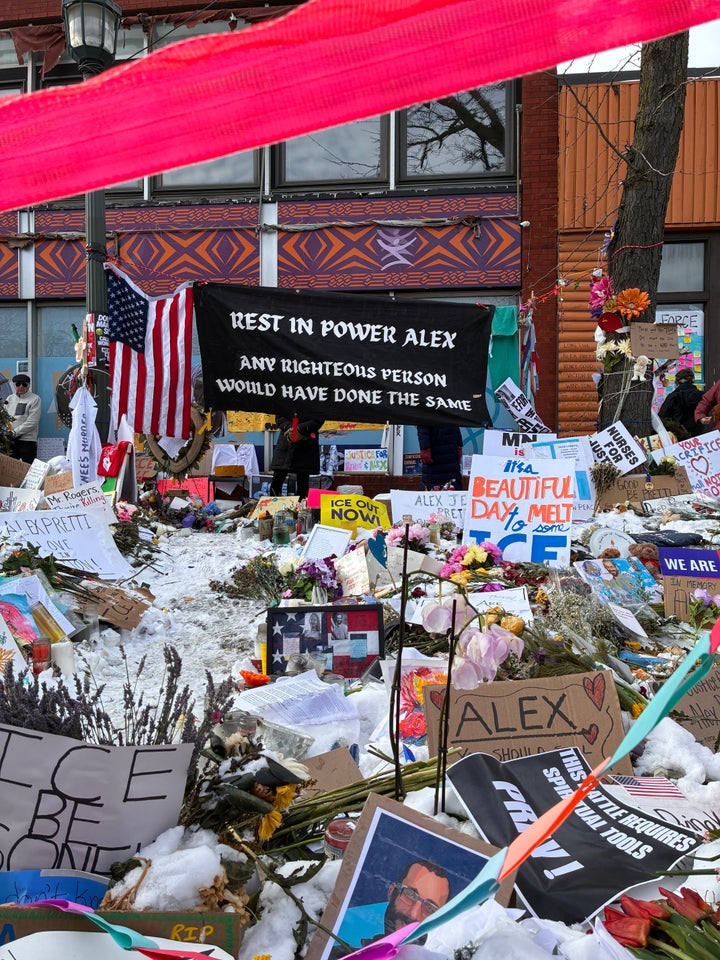
An even darker moment arrives 10 days later when ICE agents pin down Alex Pretti and shoot him in the back so many times that he appears to be dead before the last bullets pierce his body. It’s impossible to watch footage of his death, but it’s also impossible not to confirm the agents’ inhumanity with my own eyes.
As night draws near after his killing, there is an overwhelming sense that the city might fall into the same widespread pandemonium seen in the days after George Floyd’s murder. Instead, residents call for candlelight vigils to be held in every neighborhood — on every block.
At our block’s gathering of neighbors, one friend asks each of us to say a wish for our city. He begins by echoing a chant repeatedly yelled at protests across Minneapolis: “ICE needs to get the fu-” but then he slyly pauses because kids are present. Before he can continue with milder words, however, two sixth-grade girls begin shouting, “Say it! Say it!”
My friend smiles and shakes his head, No, no, I’m not going to say it. But when it’s the girls’ turn, they say it loud and clear.
And the adults cheer.
Many people viewing the occupation from outside of the Twin Cities might get the sense that it is only affecting immigrants or the observers documenting ICE’s abductions and brutality. But it’s upending the lives of every resident — in ways that we probably won’t fully understand until our kids are adults.
Even kids who aren’t at risk of being ripped away from their families are experiencing the intense trauma of the moment. A friend’s middle schooler stays at home from school because the weight of life here has become too emotionally draining. When another friend’s kid is told about her family’s upcoming trip to Naples, Florida, she asks, “Is there ICE in Naples?”
Her mom tells her, “No, nothing like here.”
And the kid wistfully responds: “You mean, we get to have five days without ICE?!”
In February, my fourth grader writes a birthday wish list. It starts with the types of things that are typical of many older elementary schoolers: stylish clothing, Lego sets, a summer camp stay. But when I scan farther down the list, I’m struck by what else she included:
“Banning ICE.”
This wish, or plea, comes immediately after what she lists as “most important”:
“Love.”
On Feb. 12, there is the tiniest hope that all of us may one day get more than just five days without ICE. Border czar Tom Homan announces that Operation Metro Surge will draw down in the coming weeks. I say “the tiniest hope” because nobody seems to believe him, especially after all of the government’s lies leading up to this moment.
According to the American Civil Liberties Union, there are still over a thousand ICE agents in Minnesota. More than 500 are slated to still be here into March. While it does admittedly feel quieter in Minneapolis two weeks after Homan’s announcement, there are now reports that the remaining ICE agents are simply becoming more secretive, so it’s unclear what a drawdown actually means, if anything at all.
But we need to hope, at least a little. We need to hope that it has been worthwhile to stand brave with our smartphones and whistles in the face of masked men wielding an arsenal of firepower. We need to hope that life can be better as we continue to donate supplies to the families who need them, to pay rent for families who can’t go to work, to alert communities to ICE’s ongoing presence. We need to believe that we’ll win as we protest, and protest and stand outside of our children’s schools until we know that everyone is safely inside.
Until my daughter’s birthday wish comes true, that is what we will continue to do.
Eric Magnuson is a Minneapolis-based author and artist whose latest work is a multimedia novel titled “ Leftover Fun.”
Do you have a compelling personal story you’d like to see published on HuffPost? Find out what we’re looking for here and send us a pitch at [email protected].
Comments (0)
No comments yet. Be the first to share your thoughts.
Sign in to leave a comment.