Israel's Restrictions on Medical Evacuations from Gaza and the West Bank
Israeli restrictions on movement and border crossings have severely limited access to medical care for Palestinians in Gaza and the West Bank, resulting in a humanitarian crisis with many patients unable to receive life-saving treatment. The closure of crossings like Rafah and increased movement restrictions within the West Bank have led to delays and deaths of patients awaiting medical evacuations, while Israel's broader policies are also seen as part of an effort to displace Palestinians and seize land. These measures have intensified the ongoing health, social, and political hardships faced by Palestinians under Israeli control.

Like thousands of others across occupied Palestine, five-year-old Mohammad Abu Asad has cancer. Mohammad was diagnosed in the early 2020s with an aggressive form of leukemia, a cancer of the blood and bone marrow. Because of the Israeli blockade, health facilities in Gaza did not have the necessary equipment to treat his illness.
In 2022, Mohammad’s family moved from Gaza to the occupied West Bank so he could have better access to cancer treatment, but his condition then deteriorated to the point that he urgently required a bone marrow transplant. Unfortunately, Israeli restrictions mean that the procedure is not available in the West Bank. Mohammad’s family consequently applied for a permit to receive care in Israel.
A hospital in Tel Aviv was willing to treat the young boy, but in early February 2026 an Israeli court rejected his petition to travel into Israel for the procedure, citing the ban on the entry of all Palestinians from Gaza that the Israeli government imposed after October 7, 2023. “I have lost my last hope,” his mother told Haaretz.
For Palestinians in Gaza, where nearly all infrastructure has been destroyed by Israeli bombs, receiving medical care is a largely hopeless prospect. Thousands of people needing cancer care, surgeries, and other complex procedures face multiple barriers keeping them from treatment. With Israel’s unprecedented physical and administrative control over how, where, and when Palestinians can move within, to, and from their territories, the dispossession of Palestinians from their rights has hit a new peak. For patients needing medical care, like Mohammad, Israel’s control is a matter of life and death.
Gaza and the Closure of Rafah
The Rafah border crossing, which Gaza shares with Egypt, has been tightly controlled by both Israel and Egypt since the imposition of the Israeli blockade in 2007. In August 2023, almost 20,000 people left Gaza through Rafah, the highest number recorded since 2012. However, historical data shows significant variation in monthly exit averages. In 2015, for example, an average of just 1,200 people were able to leave Gaza through Rafah each month, while 2022 data indicate an average of about 12,000 exits per month. In terms of goods such as construction materials and food supplies, only 37 percent entered through Rafah; the majority entered through Israel.
Similarly, very few medical evacuations from Gaza came through Rafah for treatment in Egypt. Most patients and their companions traveled from the Erez crossing into Israel, usually going on to receive treatment in East Jerusalem or the West Bank. Some patients were treated in Israel, while others were sent to hospitals in Jordan. Every month, Israeli authorities denied or delayed permits, leaving patients to deteriorate and in some cases to die while waiting.
After more than two years of airstrikes, raids, and siege, the medical sector in Gaza is nearly fully destroyed.
After more than two years of airstrikes, raids, and siege, the medical sector in Gaza is nearly fully destroyed. The surviving population of the Strip clings to life despite inadequate shelter, food, or medical care. The need for medical evacuations is significant, with an estimated 18,500 patients requiring health care abroad. However, since October 7, 2023, Israel has closed most of Gaza’s border crossings, severely limiting all movement in and out of the territory.
For a period, with bribery, corruption, and exploitation rampant as desperate people sought to leave Gaza, Rafah was one of the only crossings open. Rafah also became the main crossing for humanitarian goods, despite not being suited to handle the volume of trucks needed. Still, only 4,895 medical evacuations were completed between October 7, 2023 and May 2024, when Israel seized Rafah, essentially halting movement of people in or out of Gaza, including for medical evacuations. Efforts to compensate for the closure led to such disastrous initiatives as the US-installed floating pier and aid air drops.
In March 2025, Israel closed Rafah entirely, accelerating the humanitarian crisis in Gaza, including famine and a growing backlog of medical patients.
As part of the October 2025 ceasefire agreement, Israel committed to reopening Rafah. But just days later, Israel violated the ceasefire, announcing that the border would remain closed “until further notice.” In December 2025, Israel announced it would allow the border to reopen, but only to allow people from Gaza to leave. Egypt responded that the ceasefire terms mandated that the crossing had to be open in both directions.
It was only in February 2026, after the body of the last Israeli hostage in Gaza had been retrieved, that Israel finally permitted movement through Rafah. Between February 2 and 10, 2026, 142 patients were evacuated, 91 of whom left through Rafah. At the same time, 223 Palestinians returned to Gaza through Rafah, all of whom were sent to Nasser Hospital for additional care.
While these lucky few were able to travel, their route was not without humiliations and peril. Many reported being prohibited from leaving Gaza with anything more than a phone and documents, unable to bring clothes or even toys for their children. Those returning to Gaza reported being handcuffed and blindfolded, searched, threatened, and questioned, and having belongings and money stolen by Israeli officials. They also reported being denied medical care or even access to bathrooms.
Save the Children estimates that, at the current pace permitted by Israel, it will take over a year to evacuate all of the urgent medical cases, with a maximum of 150 people able to leave through Rafah per day—and that assumes Israel allows the maximum number to cross every day. At least 1,268 patients have already died awaiting medical evacuations.
As Israel has barred entry of Palestinians from Gaza to receive care in Israel and limited their ability to go to the West Bank or East Jerusalem, patients must not only receive permission from Israel but also find a hospital in a country willing to accept them. This requirement slows evacuations even further. One patient, desperately awaiting her own evacuation for kidney treatments after the border was reopened, succinctly explained to Al Jazeera that “[d]isease doesn’t wait for an end to hostilities. Kidneys do not comprehend the politics of opening and closing border crossings.”
Rapidly Escalating Restrictions and Danger in the West Bank
In the West Bank, Israel has leveraged its massive existing infrastructure of movement restrictions in the past few years and has now almost fully severed parts of the West Bank from each other. This round of escalation began in the fall of 2022, with closures around the northern West Bank in an effort to quell the rise of militant resistance groups such as the Lion’s Den. The restrictions remained even after the groups were largely dismantled, and were expanded after October 7, 2023.
Israel accelerated the construction of settler-only roads, inaccessible to Palestinians. Perhaps the most infamous example is in Huwwara, the site of a settler rampage in February 2023. Afterwards, Israel quickly began the construction of a settler bypass road, but settlers continued to drive on the road through Huwwara. As a result, Israeli forces banned Huwwara’s residents from crossing the road in their own town. Israel also imposed closures of businesses across the town after October 7.
Such closures and restrictions are now occurring throughout the West Bank. In February 2026, for example, Israel extended military order “Restriction of Movement and Traffic” in the areas in and around the Tulkarm, Nur Shams, and Jenin refugee camps. Israeli-defined “closure areas” are now off-limits to Palestinians unless they receive permits from the Israeli military. At the same time, Israeli forces have been raiding homes in those areas, sometimes daily, forcing families to leave while soldiers occupy their homes.
Israel has also expanded its infrastructure of checkpoints and other barriers to physical movement such as large piles of rocks and even dirt spread on roads. In 2025, at least 898 checkpoints of all types were identified across the West Bank. This number includes the proliferation of metal gates that Israeli authorities install at the entrance of villages and that they can close on a whim, without warning. When gates are closed, residents are blocked from entering or leaving their village by car. In some cases, they can attempt to travel along back roads that significantly increase travel time—and still do not offer protection from settler attacks.
Under the guise of these movement restrictions, Israel is making an increasingly explicit effort to displace Palestinians and seize their lands on the West Bank. Between official government orders, military raids, and settler attacks, the rate of displacement across the West Bank is higher than it has ever been since 1967. In many cases, settlers quickly establish illegal outposts in the communities Palestinians have fled. In February 2026, Israel approved a land registration measure that further dispossesses Palestinians from their land while facilitating settler land purchases in the West Bank.
Israel is making an increasingly explicit effort to displace Palestinians and seize their lands on the West Bank.
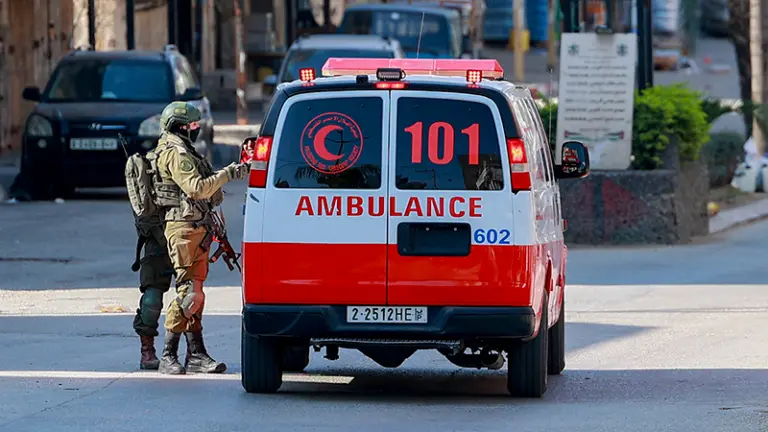
While it is impossible to capture the full humanitarian consequences of these restrictions, what has been reported so far indicates that the impact is significant. Between January and December 2025, at least 683 humanitarian access incidents were reported, including restriction of movement, operational interference (such as blocking ambulances from attending to victims injured by settler or military violence), and violence against the humanitarian personnel themselves. Increasingly, Israel is banning humanitarian personnel from entering the West Bank altogether, and working to dismantle the humanitarian infrastructure remaining, including demolishing the UNRWA compound in East Jerusalem in late January 2026.
It is not just movement within the West Bank that has been restricted. Movement in and out of the West Bank—which has always been arduous due to the Palestinians’ inability to construct their own airport—has been restricted as well. In November 2025, Israel prevented two American physicians with the HEAL Palestine nonprofit from entering the West Bank, despite having earlier approved their entry.
At some times, including September 2025, Israel closed the King Hussein border crossing between the West Bank and Jordan—the primary crossing for Palestinians to exit the territory. The closures affected patients planning to travel to Jordan for medical care, as well as prevented the re-entry of patients who had been treated in Jordan, forcing them to extend their visits at their own expense.
Movement Restrictions as Part of a Larger Picture
For decades, Palestinians, health and humanitarian workers, and human rights groups have documented how Israeli restrictions limit all aspects of Palestinian life. In this current period of genocide, mass displacement, and apartheid, these restrictions have only added to the daily burden of Palestinians who remain on their own land.
Israeli officials are becoming more explicit with affirming this objective. Bezalel Smotrich, the Israeli finance minister, recently summarized his vision for Israeli governance. “Destroy the idea of an Arab terror state; finally, formally and practically cancel the cursed Oslo Accords and get on the path of sovereignty, while encouraging migration both from Gaza and from Judea and Samaria [West Bank]…There is no other long-term solution,” he said. The settler groups that entered Gaza in late February 2026, accompanied by a government minister declaring that “Gaza will always be ours,” clearly agree.
Although it is essential to identify the mechanisms with which Israel controls Palestinian movement and to track their evolution over time, these restrictions can be recognized as part of a single, overarching project to displace Palestinians and seize their land. Considered altogether, these restrictions represent more than the humanitarian damage they cause: they are effectively tools of ethnic cleansing that are being used in clear view of the international community.
The views expressed in this publication are the author’s own and do not necessarily reflect the position of Arab Center Washington DC, its staff, or its Board of Directors.
Featured image credit: Mohammad Nazzal / Middle East Images via AFP
Comments (0)
No comments yet. Be the first to share your thoughts.
Sign in to leave a comment.