Migrant farmworkers speak out on ICE raids - Newsweek
"I'd rather be sent to Mexico than get hurt or die," one migrant farmworker told Newsweek on the condition of anonymity.

Undocumented migrant farmworkers in California and Oregon have told Newsweek they are increasingly concerned about Immigration and Customs Enforcement (ICE) activity near their workplaces and homes.
The three migrant farmworkers spoke with Newsweek on the condition of anonymity, citing concerns for their safety and the well-being of their families. About half of the United States’ 2.4 million agricultural workers lack legal immigration status, according to the U.S. Department of Agriculture (USDA).
The fear comes amid increased immigration enforcement under the Trump administration's mass deportation strategy. The Department of Homeland Security said that nearly 3 million undocumented immigrants have left the U.S. amid the Trump administration’s immigration crackdown, including an estimated 2.2 million voluntary “self-deportations” and more than 713,000 formal deportations.
During the ongoing deportation efforts, federal immigration agents have fatally shot three U.S. citizens in separate incidents under the Trump administration's enforcement operations, prompting concern among migrant communities. The three workers who spoke with Newsweek said the shootings have increased anxiety and fear within agricultural communities.
California Migrant Worker Speaks With Newsweek
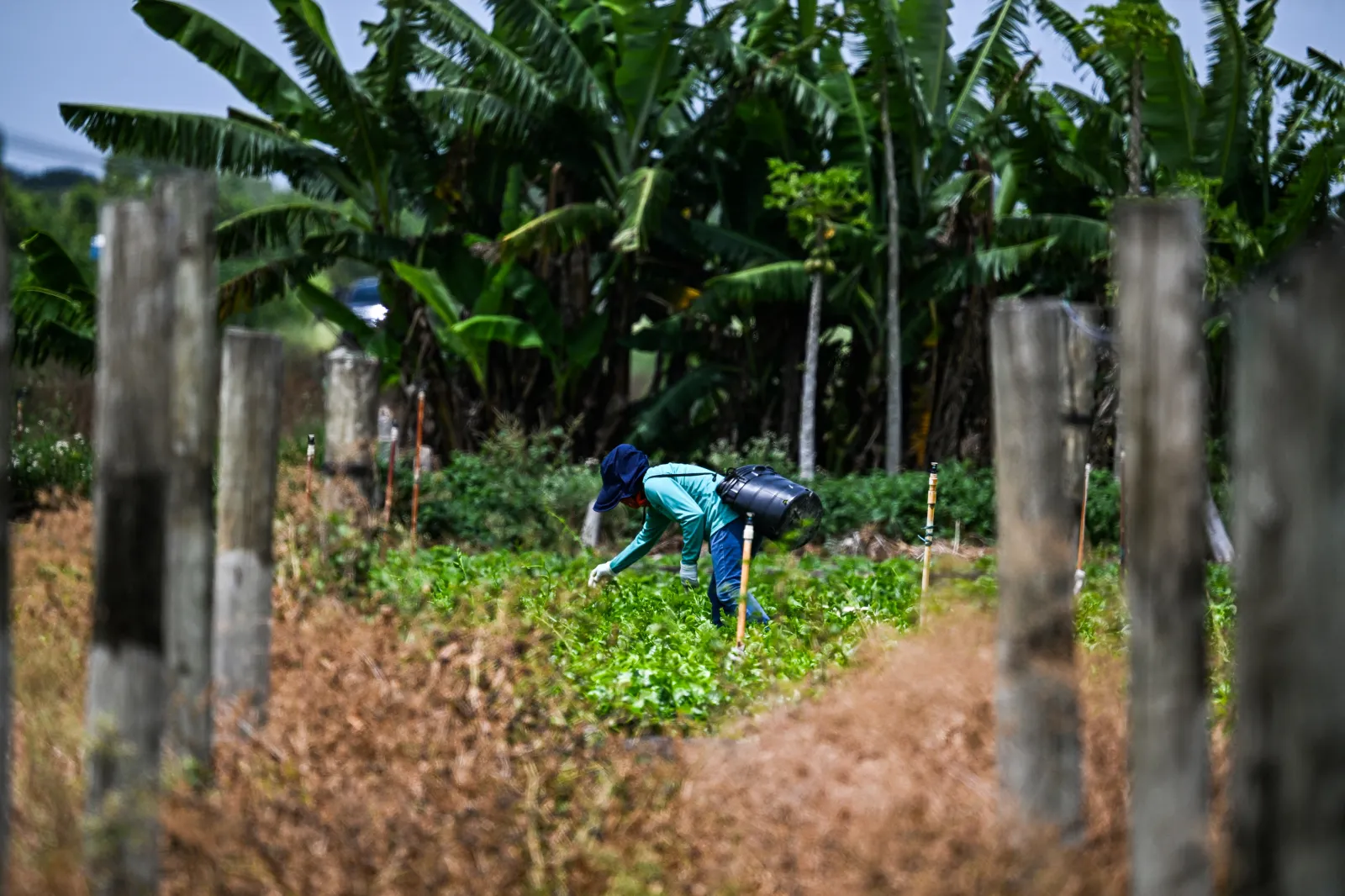
A farmworker in Riverside County, California, said she takes extra precautions when traveling to work, attending medical appointments, and caring for children, describing a sense of constant uncertainty as ICE agents frequently appear near homes, workplaces, and clinics.
"I'd rather be sent to Mexico than get hurt or die," the woman told Newsweek.
The woman accused federal agents of racial profiling immigrants in the Latino community, an allegation which the Department of Homeland Security (DHS) has consistently denied. Newsweek reached out to DHS for comment.
“I am at least more comfortable because my skin tone is lighter,” she said, “but the uncertainty of being singled out is still heavy.”
She said she has been supporting other community members, particularly indigenous language speakers, by delivering groceries, medications, and other necessities to those too afraid to leave their homes. The psychological toll extends to children, she said, some of whom have witnessed raids near schools.
"Farmworkers are hard-working people who work tirelessly, their bodies are spent by the end of the day, and we do not have time to be criminals. We are just working to provide for our families.
As the cost of living stays stubbornly high, the migrants said it's been difficult keeping up when hours worked are decreased and pay raises either haven't happened or aren't likely.
Two of the three workers interviewed said they have not received any pay increase since January 2025, with one noting that available work has also decreased. The third worker acknowledged she is unlikely to receive a salary increase due to lower sales.
One of those farmworkers is in Imperial County by the Mexican border, working in date palm harvests, and described pervasive fear even for those with legal status. She said workers across Riverside and Imperial counties carry constant stress about encounters with immigration agents.
"People are asking field supervisors to escort them home after work for safety. This is not like anything we have experienced before. During the pandemic, we were essential workers; now we are constantly scared, with reduced hours and work," the woman said.
"The impact [of what is happening to farmworkers] is greater because it is all tied to [farm] production and money," she added.
Migrants' Value in California
Undocumented Californians also play a significant role in supporting public finances. According to a 2024 analysis by the Institute on Taxation and Economic Policy, undocumented immigrants in California paid nearly $8.5 billion in state and local taxes in 2022, contributing through sales taxes, property taxes, and income taxes despite being barred from many public benefits themselves. Newsweek reached out to the Department of Commerce for comment.
Reuters reported that growers in Ventura County experienced massive absenteeism, with some operations seeing “up to 70% of workers gone” following heightened immigration enforcement.
California’s agricultural labor force is far larger than the number of jobs the industry reports on any given day due to the seasonal and transient nature of farm work. On average, the state’s farms report about 413,000 full‑time‑equivalent (FTE) jobs annually, but employers hire roughly 850,000 different farmworkers over the course of a year, reflecting high turnover and the seasonal cycle of planting and harvest. This is the commonly cited “unique workers per year” estimate for California agriculture, according to the University of California, Davis.
Oregon Migrant Worker Speaks With Newsweek
The migrant farmworker in Oregon, who requested anonymity for safety reasons, told Newsweek that concerns over ICE have led workers and their families to limit outings to essential activities, often scanning roads for unfamiliar vehicles and avoiding travel, even for leisure.
“There is no sense of normality anymore,” the woman told *Newsweek *in an interview in Spanish.
"You leave your house, and you look everywhere to check if you don’t see a suspicious car, to see if you don’t see if ICE is following you. You drive, and you don’t drive in peace because you’re thinking, ‘Oh, that truck, it has dark windows, maybe ICE is coming.’"
She recalled a recent family outing that ended abruptly because of the fear. “We went to a waterfall that is close to here, and my husband said, ‘Look, that truck is coming after us,’ and we were scared,” the woman said. “It was something we were going to enjoy, and we couldn’t do it out of fear that maybe it was ICE.”
Although the vehicle later turned out to belong to another family, the woman said the incident exemplifies how pervasive fear has become.
“We are so paranoid,” she said. "You’re afraid to go out on the street. We only go out to the basics."
Migrants' Value in Oregon
Migrant and seasonal farmworkers in Oregon number about 86,400, with dependents bringing the farmworker-household total to roughly 173,000, according to the Oregon Human Development Corporation’s Farmworker Needs Assessment. Many farmworkers travel seasonally between California and Oregon to maintain steady employment throughout the year, following crop cycles and harvest demands.
Immigrants in Oregon paid an estimated $5.6 billion in taxes in 2023, including about $3.5 billion in federal taxes and $2.1 billion in state and local taxes, according to an analysis cited by the Oregon Department of Human Services based on American Immigration Council data.
The migrant in Oregon told Newsweek that these fears have contributed to labor shortages during last year’s harvest season, particularly between July and October, with crops such as grapes, blueberries, and peaches left unharvested due to workers staying home.
“There was an entire grape harvest that rotted in the fields because they didn’t manage to harvest all the grapes due to a lack of labor,” she said.
Migrant Workers and H-2A Visas
Agriculture employers have long relied on a mix of resident workers, seasonal migrants, and temporary guest workers. In recent years, demand for formal guest-worker visas has climbed sharply as farms seek reliable, legal labor.
Ramped-up immigration enforcement and shifting federal policy are shrinking the farmworker labor pool, prompting more H‑2A visa hiring, higher labor costs, and unharvested crops.
To address farm and ranch labor shortages, the administration in October updated the federal H‑2A visa program, which lets employers hire foreign workers for temporary agricultural jobs when domestic workers are unavailable. The new rule directs the Department of Homeland Security to speed up H‑2A visa approvals.
When asked for comment, a spokesperson for the Department of Agriculture told Newsweek, “President Trump is putting America First and that includes strengthening the farm workforce and streamlining H-2A and H-2B visa programs. Our immigration system has been broken for decades, and we finally have a President who is enforcing the law and prioritizing fixing programs farmers and ranchers rely on to produce the safest and most productive food supply in the world.”
Comments (0)
No comments yet. Be the first to share your thoughts.
Sign in to leave a comment.