The Huckabee Affair: Whose Foreign Policy Is It Anyway? - Arab Center Washington DC
It is not unusual for the US ambassador to Israel to be a political appointee. Since Martin Indyk secured the post in 1995, only three of the eight men who have held it have been career diplomats. Nor is it unusual for political appointees to this post—like former AIPAC staffer Indyk and each of his successors from outside the Department […]

It is not unusual for the US ambassador to Israel to be a political appointee. Since Martin Indyk secured the post in 1995, only three of the eight men who have held it have been career diplomats. Nor is it unusual for political appointees to this post—like former AIPAC staffer Indyk and each of his successors from outside the Department of State—to be chosen for their passionate attachment to Israel. As such, they have often served as advocates for Israeli policies within the US administration and advised Israeli governments on how to navigate the corridors of power in Washington.
Enter Mike Huckabee
President Donald Trump’s Israel ambassador during his first term, David Friedman, was seen as a key player in changing official US policy on issues such as Jerusalem and Israel’s annexation of West Bank territory. As Trump’s former bankruptcy lawyer, Friedman did not lack for access to his boss and was able to promote his views directly to the president.
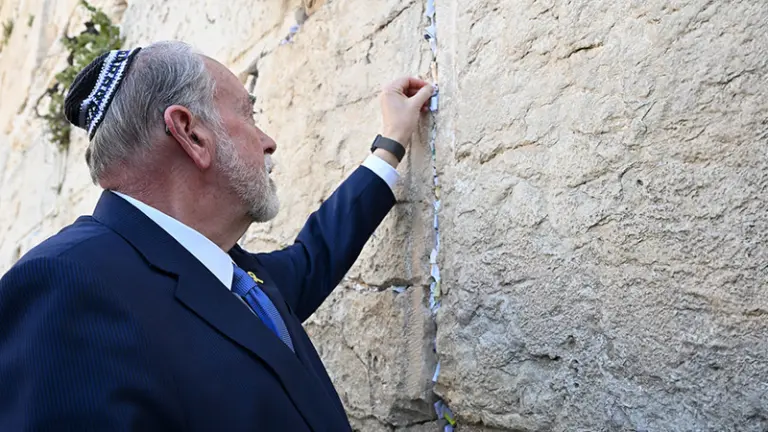
But the current US ambassador to Israel, former Arkansas governor Mike Huckabee, comes from a different mold. Although a vocal Trump supporter whose daughter, Sarah Huckabee Sanders, served as White House press secretary during Trump’s first term, he is not considered one of the president’s confidantes or part of his inner circle. Rather, Huckabee’s appointment was widely seen as a reward to the Christian Zionist constituency that played an important part in Trump’s 2024 presidential campaign, and a move to ensure their continued loyalty.
Huckabee has long been known for his extremist views, particularly on the Middle East. Speaking during his failed 2008 campaign for the Republican presidential nomination, for example, he solemnly declared that “there’s really no such thing as a Palestinian.” He also campaigned together with Israeli officials for the early prison release of Jonathan Jay Pollard, who was serving a life sentence after his 1987 conviction for spying on the United States for Israel. Similar positions are a dime a dozen throughout Huckabee’s career in the church, politics, and the media.
Huckabee’s radical views do not necessarily place him at odds with the Trump administration.
Huckabee’s radical views do not necessarily place him at odds with the Trump administration—not because he represents a consensus, but rather because there is none. As with so many of its other policies, this administration lacks both a unified approach to the Middle East and a process for formulating such an approach. Typically, it swings between various positions until Trump makes a decision, sometimes catching unawares even officials directly responsible for that portfolio.
Such circumstances create important opportunities for officials to promote positions of their own and then see whether they gain traction in Washington. Speaking out in public is one way to do so. But even by those standards, Huckabee’s tenure has been an outlier. In November 2025, Huckabee cavalierly ignored longstanding US policy of not engaging with convicted spies and, without informing the intelligence community or anyone else, convened a covert meeting with a fully unrepentant Pollard. Responding to this development, the White House went no further than stating that although it had no prior knowledge of the meeting, it “stands by” its ambassador.
The Carlson Interview
Given Huckabee’s track record, and the growing resonance of influential right-wing journalist Tucker Carlson’s criticisms of Christian Zionism and the US-Israeli alliance within MAGA circles, it was widely expected that their February 20, 2026, encounter on Carlson’s podcast would produce volatile exchanges. As it happened, Carlson’s 162-minute interview of Huckabee far exceeded an earlier encounter he had with Senator Ted Cruz (R-TX) in exposing his guest’s primordial loyalty to Israel.
Carlson framed the discussion as an effort to get to the bottom of Christian Zionism and to question that movement’s loyalty to the modern state of Israel. By the end of the podcast episode, the conversation had raised serious questions about Huckabee’s loyalty to his own country.
Needless to say, the primary role of an ambassador is to represent his or her government, to advocate for and defend its policies, and to promote the broader interests of her or his country. At times, diplomats will resort to flattery to curry favor with their hosts. A French ambassador might find it opportune to extol the quality of South African wines but would never claim that they are superior to those produced by French vineyards. If a German ambassador were to recommend American automobiles over their German counterparts, he or she would quickly become an ex-diplomat.
Yet Huckabee did exactly what no diplomat is permitted to do: throw his own country under the bus to glorify the one to which he is posted. But rather than extolling Israeli consumer products, Huckabee insisted that the Israeli military—which stands credibly accused of genocide before the International Court of Justice—fights with greater consideration for civilian life than the US military, the golden calf of the American right. When Carlson challenged him on this point, Huckabee made matters worse by failing to offer any evidence or data to support his assertion.
While Huckabee’s disparagement of the US military was his biggest faux pas as a diplomat, it was far from his most incendiary proclamation. Pressed repeatedly by Carlson on his interpretation of a verse in the Old Testament, Huckabee responded that “it would be fine” if Israel seized vast tracts of land from countries “between the Nile and the Euphrates,” including territory from states with which it has peace treaties. Each of the countries lying within Huckabee’s maximalist biblical vision are US partners. Huckabee also referred to the occupied West Bank as “Judea and Samaria” and insisted that its Area C is a part of Israel.
Dismantling US Policy Toward Israel and Palestine
The United States is Israel’s most important strategic ally in the Middle East. As witnessed during the Gaza genocide and now in the war against Iran, the US government’s support for Israel and its policies expands and grows more unconditional with each passing year. This support notwithstanding, Washington has official policies on the Palestine question, and the Middle East more broadly, that diverge from those of Israel.
Formally, at least, the second Trump administration has renounced the support it offered during its first term for Israel’s annexation of West Bank territory. The United States has also, against Israeli objections, committed to sell advanced weaponry to Saudi Arabia. In Syria, Washington supports a strong central government with the potential to exercise authority over the entire country rather than the agenda of fragmentation pursued by Israel. Even though these policies are more often than not honored only in the breach, they exist for a reason. Specifically, they are required for the maintenance of Washington’s relations with other states in the region, and with partners around the world. Unlike Israel, the United States is a global power with global interests.
Under normal circumstances, Huckabee’s statements would have been enough for him to be recalled to Washington.
Under normal circumstances, and particularly given regional governments’ furious condemnations of his views, any one of Huckabee’s above statements would have been enough for him to be recalled to Washington for consultations, if not for summary dismissal. Yet in this case the administration merely insisted that the ambassador’s unambiguous declarations had been taken out of context, while Secretary of State Marco Rubio was content to make a general statement that ambassadors should refrain from expressing views that “inflame regional audiences.” In other words, Washington’s response to the Huckabee Affair has been to take note and move on.
Almost immediately after the Carlson podcast aired, Huckabee proudly announced that his embassy would begin offering consular services in several illegal settlements in the West Bank. This development offers a further clue to Huckabee’s agenda.
Similar to Israel’s dynamic of impunity, in which its ability to act without consequence encourages it to commit ever greater transgressions, it is now obvious that the official US position on Palestine and the Middle East is being incrementally dismantled. Was Huckabee flying solo, colluding with the Israelis, or acting with the endorsement of the Trump administration—or at least key elements within it? It is difficult to know. What can be stated confidently is that Huckabee is determined to play a role in dismantling the policies of previous administrations. He has clearly surmised that there is a real opportunity for him to do so, and is acting accordingly.
From Huckabee’s perspective, the US policy priority is not Israeli expansion into the river valleys of the Nile and Euphrates. He made those statements only after being repeatedly pressed by Carlson, and because stating otherwise would have been a violation of his ideological principles. Rather, the ambassador is very much focused on facilitating Israel’s annexation of the West Bank and the incorporation of what the Israeli right calls “Judea and Samaria” into the sacred state of the Jews. He understands that while there may be much sympathy for his agenda in Washington, there is also considerable pragmatic resistance.
The Trump administration has much bigger fish to fry in the Middle East than satiating Israel’s territorial ambitions. This is especially true if the administration fears doing so might come at the expense of valuable relationships and economic opportunities with Arab and Muslim states. Huckabee’s role is to push the agenda forward, riding roughshod over objections and ensuring that what passes for the policy process swings toward his objectives.
The views expressed in this publication are the author’s own and do not necessarily reflect the position of Arab Center Washington DC, its staff, or its Board of Directors.
Featured image credit: US Embassy in Jerusalem
Comments (0)
No comments yet. Be the first to share your thoughts.
Sign in to leave a comment.