Theatre Leaders in Milwaukee: 'What We Do Counts'
Execs from more than 40 of the country’s largest regional theatres gathered in Wisconsin last week to share practical advice for an industry that is ‘exceptionally strained.’

*In late January, Joseph Haj, *artistic director of the Guthrie Theater in downtown Minneapolis, had a decision to make. Anti-immigration raids and the murder of civilians by federal agents had upended the Twin Cities for weeks. Community groups and clergy members began to organize massive citywide strikes.
“We had ICE trying to stage in our service lot,” Haj said at a recent gathering at Milwaukee Repertory Theater of 63 regional theatre leaders from around the country and Canada. “We had them in hotels right across the way. The mayor’s telling people to stay out of downtown, where we are.” Meanwhile, the theatre had Matthew López’s * Somewhere *onstage, “a play about a Puerto Rican family trying to live the American dream under impossible odds in New York City. And we had the Scottish play preparing to go into tech, which is nothing but an exploration of overweening ambition and power.”
Staffers asked Haj what he wanted to do, he recalled. His initial answer: Play. The show must go on.
“I don’t want to be cowed,” he said. “I don’t want to be silent. I feel like they would like nothing better than for us to cringe in a corner. I felt like we should play, because our art form actually matters. I have 40 years in the game, and I remain naïve enough to believe what we do counts.”
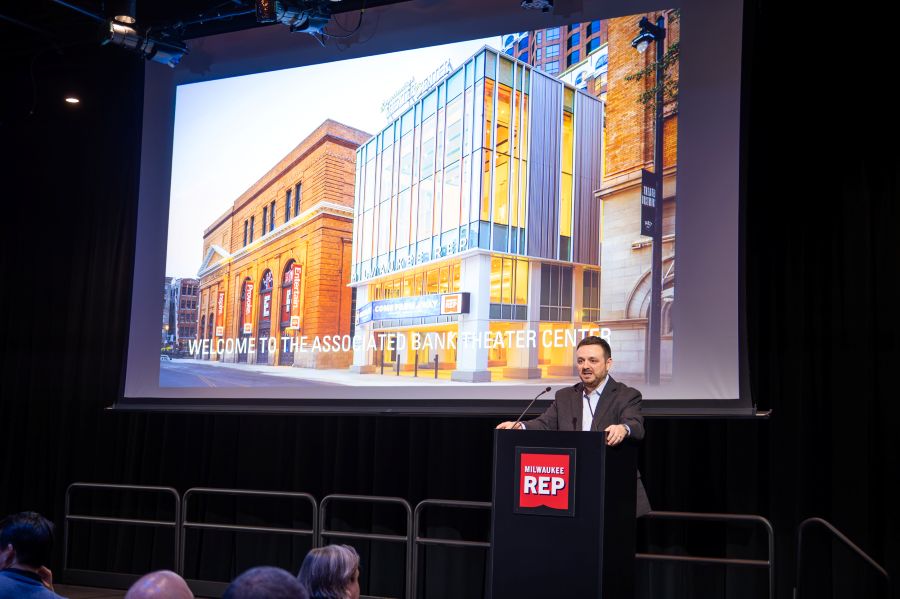
Resilience and a refocusing on the art form itself was a major theme, paired with practical advice, at the gathering titled “From Crisis to Catalyst: Transforming the Regional Theater Landscape.” Milwaukee Rep executive director Chad Bauman called this three-day event a “convening,” an opportunity for artistic and managing directors to talk together, in person, about “really big strategic issues.” Most attendees were members of the League of Resident Theatres (LORT), with a side convening of the American Theatre Critics and Journalists Association (of which this reporter is a member).
As a bonus, the Rep got to show off a major new $80.1 million renovation of its theatre spaces, which opened to the public last fall, with productions of August Wilson’s The Piano Lesson, Milwaukee Rep trustee Ayad Akhtar’s McNeal, and an opening preview of the jazzy Fats Waller revue *Ain’t Misbehavin’. *Akhtar also gave the convening’s keynote speech.

Akhtar grounded his talk in theatre history, citing institutions that were “offering (the) community a vital vision of the present, and proceeded to build a relationship around this search for the pulse of (their) time,” he said. “That’s what theatre can do that no other live form can do: It can bring the vital and new into the room with an immediacy that is transformative. It’s the thing that makes what we do irreplaceable.”
The goal of the three-day gathering, Bauman said, was to get “artistic, education, and managing leaders (to) come together to talk about impact in civic life.” While Theatre Communications Group, the publisher of this magazine, will hold an annual conference June 10-13 in San Juan, Puerto Rico, Bauman noted that TCG has “many different constituencies. They are trying to serve a much larger audience than we are,” he said. “We are trying to serve at this conference just the artistic and executive leaders from North America’s largest leader companies, which I think have a very specific role to play in the overall ecology.”
The convening sprung from the fact, Bauman said, that the “field the field in general—the 1,900 professional theatres in the United States—is exceptionally strained, the most strained I’ve ever seen in my career. We were thinking about what we could do as a company to share resources, share learning. What if we could have a space where we bring everybody together—artistic, managerial, and journalists—to talk about what we can do collaboratively, to strengthen the field and get through this moment of crisis?”
In December, a New York Times piece called the numbers for regional theatres “grim,” citing a survey from
SMU DataArtsat Southern Methodist University that showed attendance falling 19 percent and income down a whopping 37 percent between 2023 and 2024. Reporter Michael Paulson cited 72-year-old Milwaukee Rep as an outlier in this trend. In November,
Come From Awaybroke company records for revenue, likely in part due to the Rep’s newly aggressive dynamic pricing. And subscription renewals are already pacing ahead of this time last year, Bauman said.
An ‘Annie’ for Every Company
Many of the same leaders who came to Milwaukee meet on Zoom every other week to share challenges and successes—an extension of a weekly call that began during the Covid-19 pandemic. For theatre leaders like Michael Barakiva, artistic director of the Cleveland Play House, a trip to Milwaukee offered a rare in-person opportunity, one valuable enough to overcome his social anxiety.
“The answer for every regional theatre’s prosperity is radically local,” Barakiva said. “I really wanted to hear what other challenges artistic leaders were facing right now. I wanted to hear how they were solving them, not because I think there’s a silver bullet or you can photocopy it, but to think, ‘Oh, this is how they’ve assessed their really local landscape and how they’ve engaged with it,’ and maybe that will inspire us to figure out how to do the same in Cleveland.”
The Rep invited a handful of theatre leaders to lead sessions and gave them free rein with subject and panelists. Mara Isaacs, a Broadway producer of Hadestown, The Inheritance, and Gypsy, and the founder of Octopus Theatricals, hosted a panel about funding new work, a 90-minute session that was dominated by one of its panelists, author and investor James Rhee.
“We want to train theatres to think of themselves like incubators,” said Rhee’s co-panelist, composer Frances Pollock, who works with the Cultural Innovation Lab at Yale University. “We want to train them to methodically scale up projects so that you de-risk the projects, and you put capital in that’s appropriate at every step of the way.”
Pollock cited a Connecticut initiative that invests specifically in commercial ventures at theatres.
“In the same way that Goodspeed was so successful and has been so benefited by the global brand of Annie,” Pollock said of the East Haddam theatre where that global juggernaut originated, the goal is to “create a system of cultivating brands that the theatres can stay attached to, which then becomes passive revenue for them.”
Other sessions highlighted entrepreneurial leadership in nonprofit theatres and what engagement means beyond the usual talkbacks and book clubs. Jennifer Uphoff Gray from Forward Theater in Madison, Wisconsin, gave a brief overview of World Premiere Wisconsin, which brought more than 50 theatre companies together in 2023 to produce new work across the state.
“I think, post-pandemic, these jobs have only gotten harder,” said Kim Motes, executive director of Chicago Shakespeare Theater. “There’s more complexity to this work. There are degree programs in arts administration, but there’s nothing like on-the-job (training). In real life, in real time, there are issues, challenges, situations we’re navigating, and that’s where colleagues are really important.”
Motes said she has noticed in Zoom calls the signs of burnout on her passionate younger colleagues, who may take on new leadership roles only to leave the industry just months later.
“How do we ensure people are set up for success, that they’ve got a network of colleagues to touch base with?” Motes said. “You’re running a small business, an entrepreneurial business. We’ll do 11 productions this season. We’re putting out 11 new products into the world. What company, what for-profit company, puts out that many new products in a given year? We have to prepare people for these jobs.”
Working From the Center
Arguably, the most lasting and valuable advice theatre leaders may take away from a gathering like “From Crisis to Catalyst” happens outside the main events, at pre-show dinners and post-show drinks at the St. Kate hotel bar.
Meanwhile, mid-session, the questions were big ones: What is each theatre’s role and responsibility to engage with politics and current events? How can theatres mitigate risk enough to avoid relegating their most adventurous work to the smallest stages? How do theatre companies as institutions grow their audience among a generation that is inherently, and justifiably, suspicious of institutions? What does sustainability look like, as opposed to sponsorship? And how do theatres continue to incorporate principles of equity, diversity, inclusion, and accessibility while not alienating donors?
“How can the work I do show up to serve the public good?” asked Tinashe Kajese-Bolden, co-artistic director of Atlanta’s Alliance Theatre, on a panel about engagement. “I can’t alienate half of my constituents. I can’t collapse into silence, and I can’t implode into spectacle.
“The tension that I live in is when my most ardent conservative supporters and board members and donors…are emailing me and leaving voice messages and berating me because I have gone too far, there are too many queer Southern stories, there are too many stories about immigrants,” Kajese-Bolden continued. “And I’m getting a call from my most liberal-minded (patrons) who are saying, ‘You haven’t gone far enough. You need to get out in front.’ That’s the sweet spot.”
Theatre leaders have to make space for their own growth too. On the same panel, the Guthrie’s Haj reflected on his choices during the Minneapolis ICE raids. He leaned forward slightly in his chair as he allowed that keeping the shows up—his first instinct—wasn’t the right one after all.
“I badly underestimated what our staff actually needed from me and from us,” Haj said. “I had under-contemplated the care that they need, the fear that they were living in, for themselves, for our patrons, for our artists.”
The Guthrie ended up cancelling performances and rehearsals on the two days of strike, Jan. 23 and Jan. 30. As Haj realized, this is another way theatre can count: by showing solidarity and care. Haj then echoed his colleague, Snehal Desai, artistic director of the Center Theatre Group in Los Angeles. Last year, in response the 2025 wildfires, Desai said CTG decided that as a theatre company, its strongest contribution was not food banks but storytelling.
“When we work from the center of the art form, we can do astounding things,” Haj said. “When we forget that and try to do the things that we’re less qualified to do—I don’t think the world needs me to be a second-rate social worker. The minute that anybody smells that I’m just trying to be a good person, doing good in the world, nobody wants or needs me at all, because there are people who are way better qualified at providing those things for them.
“I think sometimes we undervalue the very thing that we are about.”
Lindsay Christiansis the food and culture editor of the **Cap Times***in Madison, Wisconsin.*
Support American Theatre: a just and thriving theatre ecology begins with information for all. Please join us in this mission by joining TCG, which entitles you to copies of our quarterly print magazine and helps support a long legacy of quality nonprofit arts journalism.
Comments (0)
No comments yet. Be the first to share your thoughts.
Sign in to leave a comment.