What role does local journalism play in reporting on ICE raids? - Media Diversity Institute
Local journalism in the United States has taken on an increasingly important role in covering ICE raids, providing real-time, community-specific information that national outlets often overlook, including legal explainers, individual migrant stories, and local law enforcement policies. Outlets such as Minnesota Public Radio and Fresnoland have seen significant audience growth as communities seek accurate information about ICE operations, with Minnesota Public Radio ranking as the top local public radio outlet in the U.S. by web traffic in late 2025. Local and nonprofit newsrooms have also worked to counter disinformation and clarify complex legal distinctions — such as pending asylum cases and visa processes — that mainstream media have been criticized for failing to adequately explain. Journalists and editors from these outlets describe local media as a "vital lifeline" for immigrant communities, particularly for disseminating "Know Your Rights" information in accessible language.

By Santiago Bracho
ICE raids** and increasing public anger**
In the wake of Immigration and Customs Enforcement (ICE) increasing its raids across the United States, many Americans and migrants are turning to local news to best inform themselves on how and where ICE is operating, and combating common media misconceptions and disinformation spread about US immigration.
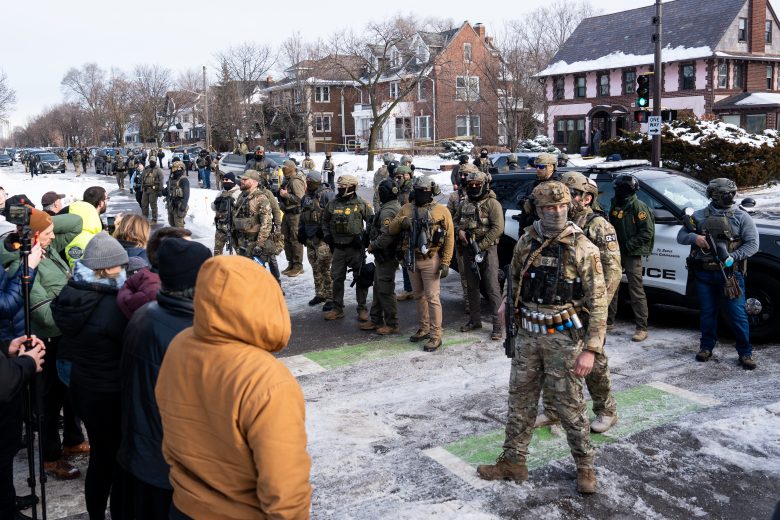
Emboldened by the Trump administration and with expanded powers, ICE has been carrying out mass operations to deport undocumented immigrants across the country. In February 2026, the situation escalated with the death of two American citizens by ICE agents in Minnesota, claiming they were both interfering with detainments.
Local media in the state of Minnesota, which has been the centre of many recent ICE raids, have seen dramatic increases in audience.
A report by Neiman Labs revealed that the local radio station, “Minnesota Public Radio, finished the fourth quarter of 2025 as the No. 1 local public radio outlet in the United States in terms of web traffic”, which they believe is due to reporting of mass civilian demonstrations against ICE raids.
Another key Neiman Labs report has shown a rise in web traffic to local news organisations across multiple American cities where ICE raids have increased.
Local journalism holds a key role in directly reporting within migrant communities, highlighting the stories and struggles of undocumented migrants at a time when the US government and some media organisations are targeting them.
*Has the media informed the public on the limits of ICE’s mandate? *
The increase in ICE raids has brought into question the powers it has under the law, including conducting traffic stops, brandishing firearms, and concealing their faces without ID.
Those actions have resulted in multiple legal arguments and court cases. Major international news organisations, such as the BBC and CNN, have published ‘explainers’ on ICE’s legal parameters to clarify this controversy for the public.
Many local journalist organisations have also played a decisive role in drawing attention to local law enforcement operations and policies, and to how they have interacted with and differed from ICE’s current operations.
For example, the Maine Monitor published an extensive article regarding Maine’s law enforcement policies on officers presenting identification and stating their names when stopping someone. Due to ICE agents often wearing face coverings, the Maine Monitor sought to contrast these tactics with those of most established law enforcement in the state. The article further provides a list of all the Maine police departments and their policies on officers identifying themselves by name.
Across the US, different states and even different towns within states have different policies regarding this key issue. These local reports provide communities with key information on how national issues are currently being addressed in their state and towns.
*Local Media and CSOs calling out ICE’s abuse of power *
ICE’s expanded powers and the legality of its current mandate have attracted international media attention, particularly regarding its use of force and detention. Who they target for “breaking immigration law” has also attracted media coverage.
ICE’s expanded deportation of irregular migrants has targeted many who are currently in the process of appeals, between visa changes, or under a rarer immigration status. This was on display in the summer of 2025, when ICE made it a standard policy to detain migrants who were attending an immigration tribunal. Previously, this action could only be done in the most extreme cases affecting citizens’ safety, under the process of “expedited removal”, which the Trump administration has now expanded to apply to those who have “entered the US without permission and have spent less than 2 years in the US”. As of February 2026, ICE now has the authority to detain asylum seekers and people under legal refugee status, under the pretext of a check of their current legality in a process called “detain-and-inspect”.
As journalist Giselle Medina told MDI, “large national media outlets have often failed to clearly explain the factual narratives of immigration communities”. Medina says much of the US media tends to frame this narrative in a binary framework, in which coverage tends to ignore “legal distinctions, such as pending asylum cases, active appeals, or valid visas still being processed”. It has fallen upon local media and human rights organisations to report on individual cases of detainment.
In Minnesota, local journalist Atra Mohamed reports on how Bahjo Abdi, a Somali asylum seeker, went for a routine monthly check-in with ICE authorities and was detained and held in El Paso, Texas, for two weeks. Examples such as these bring to life how ICE raids are affecting vulnerable communities across the US.
In June 2025, the National Immigration Justice Centre represented multiple asylum seekers who were due to be deported to “Cuba, Venezuela, the Republic of Guinea, and the Chechen Republic”, with many fearing for their safety due to their LGBT identity.
Local activism and reporting are playing an essential role in telling these stories, where national media have ignored them. As Medina told MDI, “Hyper-local nonprofit newsrooms have stepped into that gap. They are closely tracking federal bills, court rulings, and executive actions, then translating them into straightforward, accessible information.”
Local Journalism’s role in telling migrants’ stories
The reporting on ICE raids has highlighted the importance of local media. The ability to focus on a specific area can give more direct information in an ongoing situation, which national news might not cover as quickly.
In a ‘Fresnoland’ article (a local news site for Fresno, California), reporter Gisselle Medina wrote that several businesses across Fresno have become “informal information hubs” for community members who are afraid of an ICE raid.
Kishor Panthi, the editor-in-chief of NepYork, a journal focusing on the Nepalese community in New York, further echoed these sentiments, telling MDI, “Local journalism serves as a vital lifeline for immigrant communities in the US. For many individuals, these local and language-specific outlets are the primary source of ‘Know Your Rights’ information.”
Most citizens do not know how to decipher complex laws and legal jargon. These local news sources have become key for providing information to vulnerable communities and fighting disinformation.
Local journalism can be essential to establishing community cohesion. Through community engagement, local media provide a platform for underrepresented people, such as undocumented migrants.
Comments (0)
No comments yet. Be the first to share your thoughts.
Sign in to leave a comment.