American power play in the South Caucasus - EPC
U.S. Vice President JD Vance's visit to Armenia and Azerbaijan underscores Washington's efforts to increase influence in the South Caucasus, focusing on peace, security, and energy cooperation, including the sale of reconnaissance drones and infrastructure investments. Key initiatives include the US–Azerbaijan Strategic Partnership and the proposed transit corridor TRIPP, aimed at regional economic integration and reducing Russian and Iranian influence. The visit also reflects America's strategic interest amid regional tensions, while the European Union observes these developments as opportunities to bolster stability and connectivity, though full European involvement remains uncertain.

The recent visit by US Vice President JD Vance to Armenia and Azerbaijan underlines the ongoing geostrategic recalibration of the South Caucasus. Washington framed the trip as a push for peace and prosperity within the US-led Armenia–Azerbaijan peace process, building on the 8 August 2025 trilateral summit agreements. However, it was also very much about advancing and projecting US influence. The EU should welcome this engagement, as it may help curb Russian and Chinese influence while complementing the EU’s own efforts to reinforce stability, energy security, defence and economic cooperation, including key connectivity projects.
Vance became the first sitting US Vice President to visit Armenia. The visit resulted in several bilateral agreements, including the announced sale of $11 million in US reconnaissance drone technology. This included an agreement on civilian nuclear cooperation aimed at reducing Yerevan’s energy dependence on Russia. Vance also announced that Washington was ready to export advanced computer chips, including high-powered NVIDIA GPUs, and to invest in various infrastructure projects.
These developments come ahead of Armenia’s pivotal 7 June parliamentary elections and are likely to boost Prime Minister Nikol Pashinyan’s campaign. For Washington, leadership continuity is seen as crucial to safeguarding the 2025 peace framework and Armenia’s Western trajectory. The agreements also offer Armenia deeper integration with Western markets and investors, thereby reducing reliance on Moscow for energy and defence.
In Azerbaijan, Vance highlighted the country’s role as a critical transit and energy hub linking the Caspian basin to Europe. A new US–Azerbaijan Strategic Partnership Charter was signed, covering energy, digital infrastructure, defence and economic cooperation. Vance also announced enhanced security support, including plans to provide coastal patrol boats for Caspian Sea operations, marking an expansion of US military cooperation with Baku.
At the heart of both visits was connectivity, notably the US-backed “Trump Route for International Peace and Prosperity” (TRIPP) – a proposed transit corridor that would pass through Armenia and link Azerbaijan to its exclave of Nakhchivan, facilitating transit between Central Asia and Europe while bypassing Russia and Iran. The corridor is presented as a confidence-building mechanism to promote economic integration following decades of conflict. It also represents an opportunity for Washington to showcase leadership and reduce Russian leverage in the region.
However, it is still early days. Progress depends on Armenia and Azerbaijan signing a peace deal, and hurdles relating to funding, geography, logistics and security remain unresolved.
Vance’s decision not to visit Georgia, previously an important US partner, underlines Washington’s prioritisation of the Armenia–Azerbaijan peace track and energy‑focused initiatives. Georgia’s recalibrated relations with Russia, deepening ties with China, anti-US rhetoric, and an ongoing political crisis have made Tbilisi a less attractive partner. Prime Minister Irakli Kobakhidze’s announcement that he is ready to resume a strategic partnership with the US and expects “steps” from Washington fell on deaf ears.
Moscow is displeased
The Kremlin is unlikely to welcome this renewed US engagement. Growing Western influence challenges Russia’s traditional dominance in Armenia and the wider region. Kremlin-aligned analysts have sought to discredit Washington's reliability and motives, accusing it of seeking to seize the South Caucasus and of interference in Armenia’s internal affairs. This narrative rings hollow, given Russia’s massive operations, including disinformation campaigns, aimed at preventing Pashinyan’s re-election. At the recent Munich Security Conference, President Ilham Aliyev also accused Russia of deliberately targeting Azerbaijani energy infrastructure and diplomatic facilities in Ukraine.
Good for the EU, too
Although many elements remain to be defined, the visit represents an important step towards deeper economic and security cooperation. It may contribute to regional stability and support both countries’ efforts to diversify their foreign policies. Aliyev’s and Pashinyan’s decision to join President Trump's Board of Peace can also be seen as a step to strengthen ties with Washington.
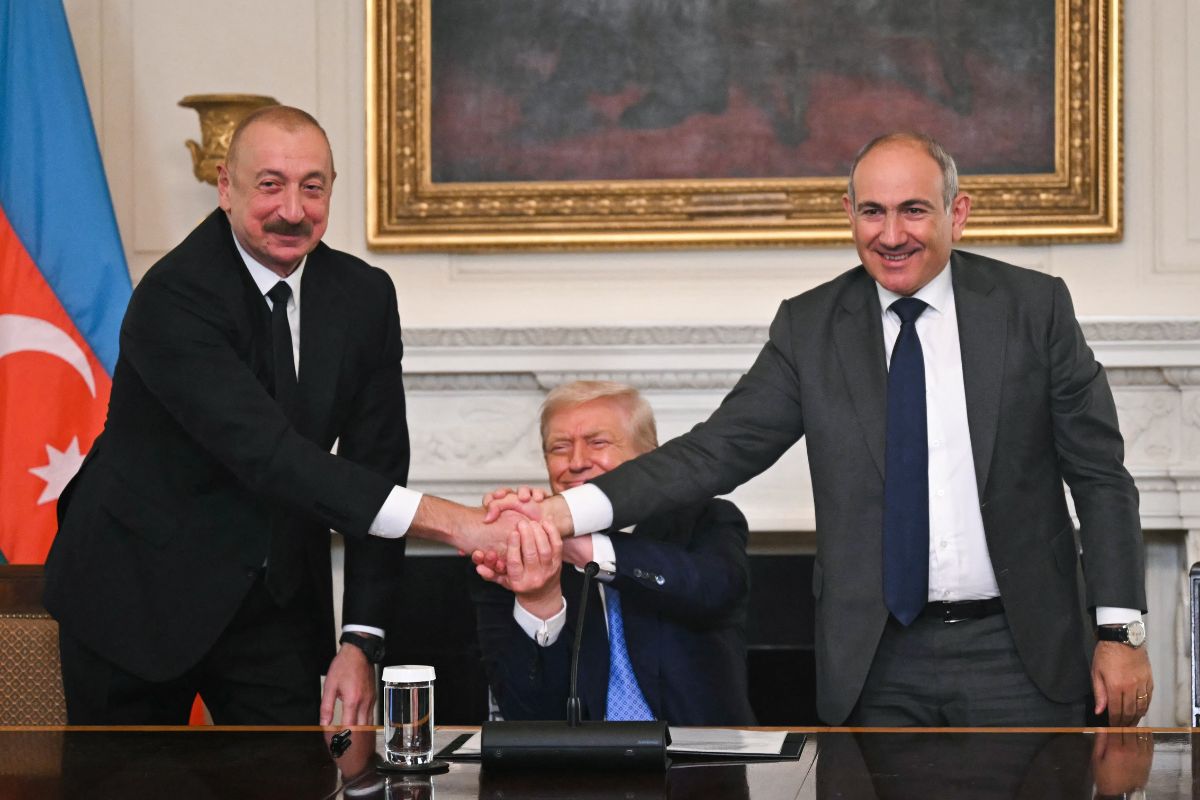
Azerbaijani President Ilham Aliyev (L), Armenian Prime Minister Nikol Pashinyan (R) and US President Donald Trump shake hands during a trilateral signing ceremony in the State Dining Room of the White House in Washington, DC, on August 8, 2025.
Photo by: ANDREW CABALLERO-REYNOLDS / AFP.
US engagement may be driven by economic interests and a desire to reposition itself in a region long dominated by Russia. Nevertheless, its stated focus on peace, security and prosperity should be welcomed in Brussels. It also aligns with and may reinforce the EU’s growing partnerships with both Azerbaijan and Armenia, the latter now aspiring to join the EU. Through its Monitoring Mission in Armenia (EUMA), the Union has become an important security actor, observing and reporting on developments along the Armenia–Azerbaijan border, supporting human security and confidence-building. The EU–Armenia security and defence consultations are helping Armenia boost its resilience, including against hybrid threats, ahead of the elections.
While the EU has not formally endorsed TRIPP, the corridor could form part of a broader connectivity network linking Europe with the South Caucasus and Central Asia. It may also open investment opportunities for European businesses.
Europe’s experience with economic integration, regulatory convergence and commercial standards will become increasingly relevant to help attract investment, particularly if funding and guarantees are tied to strict procurement, anti-corruption and transparency standards. However, meaningful European involvement depends on whether Washington chooses to invite the EU into the project – a step that has yet to materialise.
Amanda Paul is Deputy Head of the Europe in the World Programme and Senior Policy Analyst.
The support the European Policy Centre receives for its ongoing operations, or specifically for its publications, does not constitute an endorsement of their contents, which reflect the views of the authors only. Supporters and partners cannot be held responsible for any use that may be made of the information contained therein.
Comments (0)
No comments yet. Be the first to share your thoughts.
Sign in to leave a comment.