Here's how the SAVE Act could radically change voting in Illinois - NBC 5 Chicago
Lawmakers are still battling over the SAVE America Act, which could fundamentally change the way voters cast ballots in Illinois.

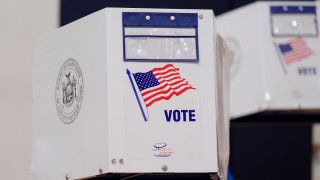
Voting booths at a polling station inside Frank Sinatra School of the Arts High School in the Queens borough of New York, US, on Tuesday, Nov. 4, 2025. New Yorkers heading to the ballot box to select a new mayor face stark choices: a youthful socialist, a seasoned ex-governor or a red-beret-wearing radio host. Photographer: Adam Gray/Bloomberg via Getty Images
Lawmakers are still battling over the SAVE America Act, which could fundamentally change the way voters cast ballots in Illinois.
The measure passed the House of Representatives last month, and President Donald Trump has continued to press lawmakers in the Senate to approve the measure, including during his State of the Union speech last week and on his TruthSocial platform on Thursday.
Stream NBC 5 for free, 24/7, wherever you are.
WATCH HERE

"The Republicans MUST DO, with PASSION, and at the expense of everything else, THE SAVE AMERICA ACT - And not the watered down version. This is a Country Defining fight for the Soul of our Nation!,” he said.
Trump has also repeatedly called for mail-in ballots to be restricted to those who are ill, disabled, serving in the military or traveling abroad. His argument for the bill has been predicated on his false claims that he won the 2020 election, with the president also making unsubstantiated claims of widespread voter fraud.
Only a handful of cases of voter fraud were discovered in the 2024 election cycle, and investigations have routinely shown no widespread fraud had taken place.
The original version of the legislation called for voters to prove their citizenship when casting ballots, but lobbying by Maine Sen. Susan Collins led to that requirement being changed to a photo ID.
Provisions of the current SAVE Act would require voters to present proof of citizenship, such as a birth certificate or passport, to register to vote in all 50 states.
Local
The measure would also require all Americans to present a valid photo identification when casting ballots at their polling places.
The bill could impact mail-in voting as well, with voters required to submit copies of their identification when requesting a mail-in ballot. Finally, voter rolls would have to be submitted to the Department of Homeland Security’s “SAVE” System periodically for verification.
Illinois does not have a voter ID law in place, meaning that voters do not have to present a photo ID when they cast ballots. Voters are sometimes encouraged to use a photo ID when questions arise at their polling place, but no law explicitly requires it.
To register to vote in the state, voters must present two forms of ID, including a photo ID such as a driver’s license, that proves their current address.
Mail-in ballots in Illinois can also be requested by any voter, regardless of reason.
Democratic lawmakers have been strongly opposed to the bill, and it faces an uphill climb in the Senate, with the measure lacking the 60 votes that would be required to overcome a filibuster in the chamber.
Lawmakers have cited research conducted by the Brennan Center for Justice, which shows more than 21 million Americans lack access to a passport or their birth certificate, and that roughly half of Americans don’t have a passport at all, complicating efforts to provide proof of citizenship.
In addition, many Americans lack access to paper copies of their birth certificate, according to the study.
Activism groups have also argued that millions of women could be disenfranchised because their married names don’t match those on their birth certificate or passport. That list of opponents includes The League of Women Voters, who blasted the legislation in February when it passed the House.
“Under the false banner of ‘election integrity,’ lawmakers are advancing policies designed to block lawful voters from participating in our elections — particularly rural voters, voters of color, and nearly 70 million married women who have changed their last names, along with other voters who have been historically marginalized and already face barriers to casting a ballot. This is modern-day voter suppression, plain and simple,” the organization said in a press release after the bill’s passage in the House.
Lawmakers in Illinois are divided on the measure. Republican Illinois Rep. Darin LaHood wrote an op-ed prior to the 2024 election calling for the measure to be passed by Congress.
“Congress must continue to work to secure our elections, and this commonsense legislation is the first step toward bolstering election integrity, gaining more public trust in the electoral process and further preventing the chance of illegitimate ballots being cast,” he said.
Illinois Gov. J.B. Pritzker has also argued against the bill, arguing that it’s a voter suppression measure that isn’t “about stopping fraud.”
Comments (0)
No comments yet. Be the first to share your thoughts.
Sign in to leave a comment.