Inside The Star Tribune's coverage of the Minneapolis immigration raids - Poynter
Publisher and CEO Steve Grove shares how the paper balanced aggressive reporting with care for journalists covering a deeply personal story

This is The Poynter Report, your daily guide to the news about news. Subscribe to get it in your inbox every weekday.
One of the biggest news stories of 2026 has been the immigration enforcement operations in Minneapolis, and the protests that have gone along with those operations. Some 4,000 federal agents descended on the Twin Cities back in January, sparking a story that gathered massive national attention.
The story tragically gained even more attention on Jan. 7 when Renee Good, a poet and mother of three, was shot and killed by a U.S. Immigration and Customs Enforcement agent. Two weeks later, an ICU nurse named Alex Pretti was shot and killed by a Border Patrol agent.
As I said, this was a huge national story.
But it was also a really big local story for the people of Minnesota and the Twin Cities and, in particular, Minneapolis.
It was during this time that The Minnesota Star Tribune provided — and continues to provide – coverage that has been thorough and insightful, but also sensitive and moving and fair and very personal.
In the latest episode of “The Poynter Report Podcast,” out today, I talk with Star Tribune CEO and publisher Steve Grove about that coverage, including what it’s like for journalists to cover a story that’s extremely personal. They are covering events that are happening in the neighborhoods where they live, where they grew up, where their kids go to school and where they buy their groceries.
For them, this story is, in many ways, about them.
Grove told me there’s no doubt that the stress is much higher for the local reporter than for a national reporter who swoops in from out of town.
“It is more personal,” he told me. “(But) I also think that makes the coverage better. Our local journalists know our leaders. They know the context. They know the neighborhoods, the intersections, the streets, the shops. There’s just a head start in the reporting when it’s your community. But you know the toll it takes on you when it’s your own neighbors and friends. I mean, there’s not a person in our newsroom or organization who wasn’t personally affected, at least in one way or another, by this crisis. And, you know, I think that’s why local news is special, but it does require extra care as an organization to make sure we’re taking care of each other.”
The Star Tribune has masterfully guided its newsroom through this story, making sure to provide the best coverage possible while also making sure its journalists are safe and healthy.
Grove has an interesting background in journalism, tech and politics. And now he has returned to journalism and his home state to take over a local news organization.
We talk about the importance of local news and what the future holds for The Star Tribune. And we also do a deep dive into The Star Tribune’s coverage of the federal immigration operations and the protests, as well as the arrest of Don Lemon and others, and how to keep journalists safe while they cover such a volatile situation.
I think you’ll find this a worthwhile conversation, especially at this moment when local news is at a crossroads. Aside from watching on YouTube, you can also find the show on Apple, Spotify, and most places where you find podcasts.
The Trump exclusives
You see this every now and then. A big news story breaks involving President Donald Trump. A journalist calls Trump on his cellphone. And believe it or not, Trump answers. Apparently, for as much as he says he loathes the media, he loves talking to reporters.
So Trump answers and then the journalist immediately reports that he or she had an exclusive interview with the president.
Technically, that’s true. Although more often than not, that “exclusive” interview consists of no more than one or two questions and lasts maybe a minute or two. (The New York Times’ Zolan Kanno-Youngs said his phone conversation with Trump over the weekend lasted about six minutes.) Trump occasionally says something newsworthy in these ever-so-brief exchanges. And, often, he doesn’t say much at all.
Over the past few days, following the U.S.’s attack on Iran, there have been plenty of Trump “exclusives.”
The Washington Post’s Scott Nover reported, “Among the many interviewers: Natalie Allison of The Washington Post, Zolan Kanno-Youngs of the New York Times, Kristin Welker and Peter Nicholas of NBC News, Jake Tapper of CNN, Bret Baier and Jacqui Heinrich of Fox News, Jonathan Karl and Rachel Scott of ABC News, Barak Ravid of Axios, Michael Scherer of the Atlantic, Nikki Schwab of the Daily Mail, Jon Levine of the Washington Free Beacon, Mychael Schnell and Laura Barrón-López of MS NOW, Steven Nelson of the New York Post, Connor Stringer of the Telegraph, Dasha Burns of Politico, and Libby Blanca Alon of Israel’s Channel 14 News.”
In this case, because you never know with Trump, you can’t tell whether the president answering so many calls is part of a strategy to defend the U.S’s actions in Iran or if it’s just Trump being Trump. But it’s still a big deal for an outlet to have Trump speak to them.
Mark Feldstein, a journalism professor at the University of Maryland, told Nover, “It’s impossible for news outlets to resist playing up the immediacy of an exclusive interview with a president in the midst of battle, no matter how pedestrian his comments may be. This tactic allows Trump to be everywhere all at once, without the formality of an Oval Office address or the pushback of obstreperous questions at a news conference.”
The point being that Trump can end the call when he chooses, as opposed to being in a press conference setting where it’s more difficult to do that.
However, Trump did speak to a group of reporters at the start of a White House meeting with Chancellor Friedrich Merz of Germany on Tuesday. His comments were, if nothing else, blunt.
The New York Times wrote Tuesday, “Officials with access to U.S. intelligence have said that Mr. Trump has exaggerated the immediacy of any threat Iran posed to the United States.”
But Trump told reporters, “We were having negotiations with these lunatics, and it was my opinion that they were going to attack.”
When asked if Israel had forced his hand, Trump said, “If anything, I might have forced Israel’s hand.”
That bluntness continued when he was asked about the worst-case scenario for Iran. Trump said, “I guess the worst case would be we do this and somebody takes over who’s as bad as the previous person. Right, that could happen? We don’t want that to happen. It would probably be the worst, you go through this and in five years you realize you put somebody in who’s no better.”
More notable journalism regarding the Iran story
- CNN commentator David Axelrod tweetedon Tuesday, “A week ago, in his State of the Union speech, @POTUS boasted that the stock market was rising and gas prices were falling and we were living in a new Golden Age. He spent one paragraph on Iran. This is the headline this morning.” Axelrod then tweeted a blaring headline across The New York Times website on Tuesday: “Stocks Fall and Oil Prices Surge on Warning of Extended War.” - For Wired, Mahmoud Aslan with “How Journalists Are Reporting From Iran With No Internet.” - The Guardian’s Aisha Down with “Internet blackout is tool of desperate regime to isolate Iranians, say experts.” - The Washington Post’s Warren P. Strobel, Karen DeYoung, Ellen Nakashima and Michael Birnbaum with “White House rationale for war keeps shifting.” - News analysis from The New York Times’ Anton Troianovski: “You Break It, You Own It? Not for Trump When It Comes to Iran.” - In a visual analysis from The Wall Street Journal, Anat Peled, Milàn Czerny, Dov Lieber and Anika Arora Seth with “Inside the Operation That Killed Khamenei.”
The meeting that never happened
Last week, right before Netflix announced it was essentially giving up its pursuit of Warner Bros. Discovery, Netflix co-CEO Ted Sarandos went to the White House for a meeting. Reports were that Sarandos was not going to see President Donald Trump, but that he was going to meet with White House officials.
Turns out, he didn’t meet with anyone. Axios’ Sara Fischer reported, “Sarandos was informed shortly after arriving at the White House that his meeting was canceled because of a last-minute scheduling conflict, and then he promptly left the building.”
A short time later, Netflix announced it wouldn’t up its bid for WBD, thus paving the way for Paramount to acquire the company. Sarandos, however, told Bloomberg that Netflix had already decided to drop out of the bidding war before his scheduled meeting at the White House.
Fischer wrote, “Trump talked to Sarandos on the phone later that evening after Netflix had already announced it didn’t plan to continue bidding, a source familiar with the matter told Axios.”
The question that remains is how much did Trump impact the whole deal. He has a good relationship with Paramount CEO David Ellison and it’s believed Trump wanted Paramount to buy WBD because WBD owns CNN. And Trump wants changes to be made to CNN.
Paramount’s bid to buy WBD always included WBD’s cable properties, including CNN.
Netflix’s offer, however, did not include CNN. And that, reportedly, bothered Trump.
Sarandos told Bloomberg, “Once it was clear that we weren’t in the CNN business, it was a lot less interesting. He didn’t care that much more about our deal.”
An AJC podcast
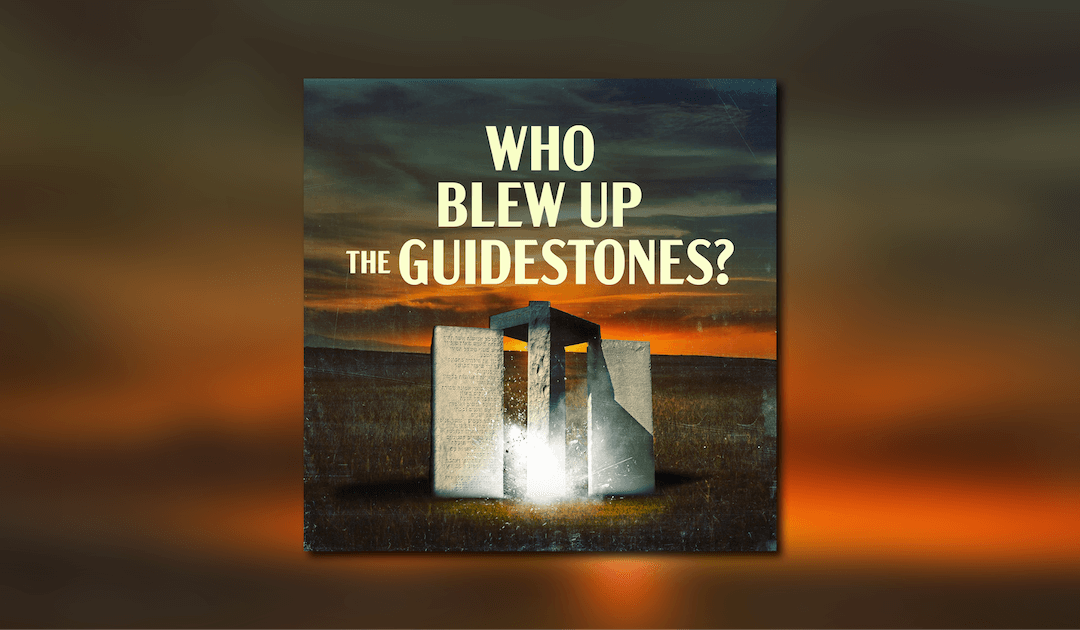
The title card for a new podcast from The Atlanta Journal-Constitution. (Courtesy: The Atlanta Journal-Constitution)
The Atlanta Journal-Constitution is coming out with an interesting new podcast: “Who Blew Up The Guidestones?”
The AJC said the pod will lead “listeners down a curious rabbit hole to uncover the truth behind the fabled Georgia Guidestones — six granite slabs, some with inscriptions, that stood for 42 years in an empty plot of land in North Georgia ― and who may have ultimately been responsible for their explosive demise in 2022.”
The six-part investigative podcast is led by journalist Tyler McBrien and takes listeners through several decades of intrigue. The AJC says, “The show tackles questions surrounding the structures and what they represented in American and Georgia’s cultural history at the time of their placement and destruction.”
You can subscribe to the podcast and listen to the trailer here. Episodes 1 and 2 premiere on March 17.
Media tidbits
- Nieman Lab’s Sarah Scire with “New York Times runs in-house ad asking listeners to “support any news organization dedicated to original reporting.” - Former “Good Morning America” co-host Joan Lunden has published her memoir, “Joan: Life Beyond the Script.” - Maria Briceño and Loreben Tuquero of Poynter’s PolitiFact with “A viral audio clip accusing the Clintons in the Epstein case was created with AI.” - CNN’s Liam Reilly with “HBO Max and Paramount+ will combine after WBD merger.”
More resources for journalists
- Audit your crime coverage, implement a sustainable newsroom policy and learn to do more meaningful work with fewer resources. Limited time left to apply. - New editors: Get guidance from industry veterans and build the skills you need to become indispensable to your newsroom. Apply now. - Reporters and editors with ambition to do investigative journalism: Get guidance from ProPublica’s Alexandra Zayas in this five-week, hands-on seminar. Enroll today. - Get the tools, mentorship and peer community to turn your non-fiction book idea into a publishable proposal. Apply for our workshop today.
Have feedback or a tip? Email Poynter senior media writer Tom Jones at [email protected].
The Poynter Report is your daily dive into the world of media, packed with the latest news and insights. Get it delivered to your inbox Monday through Friday by signing up here. And don’t forget to tune into our biweekly podcast for even more.
Comments (0)
No comments yet. Be the first to share your thoughts.
Sign in to leave a comment.