NATO shifts air surveillance focus from Russia to Iran - Bloomberg
NATO has shifted its air surveillance focus from Russia to Iran amid rising tensions and the potential for a US-led military strike against Iran, with increased deployment of radar planes and preparations by Turkey for possible conflict. The US has positioned fighter jets and military assets in the Middle East, while Iran has expressed readiness to negotiate but remains cautious about a potential strike. The escalating situation has fueled domestic and international anxiety, with lawmakers and officials closely monitoring developments ahead of possible military action.

NATO shifts air surveillance focus from Russia to Iran - Bloomberg
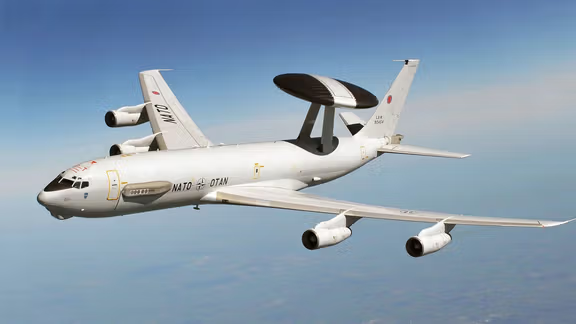
NATO has shifted the focus of its air surveillance operations in Turkey from Russia to Iran as the risk of a US-led military campaign against Tehran rises, Bloomberg reported, citing people familiar with the matter.
The alliance has increasingly deployed its AWACS radar planes from the central Anatolian city of Konya to monitor Iran, the report said.
The report added that Turkey is making preparations for a possible US-led strike against Iran, a move the sources cited by Bloomberg said could force Tehran to make concessions on a number of issues, including curtailing its nuclear program, followed by a wider attack if Iran refuses to do so.
Turkey has updated its contingency plans to prepare for large numbers of displaced people in the event of a major conflict, the report said.
These options range from setting up camps near the border or entering Iranian territory to stop refugees from crossing into Turkey, Bloomberg added citing its sources.
"The latter would only be considered in the case of a power vacuum in Iran."
The US military has begun moving 12 F-22 stealth fighter jets toward the Middle East after they were stationed at an airbase in the United Kingdom in recent days, The Times of Israel reported citing open-source flight tracking data and aircraft spotters.
The report said the F-22s were seen taking off from Royal Air Force Lakenheath in England and linking up with KC-46 refueling planes as they headed toward the region. The jets had arrived at Lakenheath last week and remained there for several days, reportedly due to issues with refuelers.
Dozens of fighter jets — including F-35s, F-22s, F-15s and F-16s — have been spotted heading to the region in recent days, according to the Military Air Tracking Alliance, a group of open-source analysts that monitors military and government flight activity.
The team also said it tracked dozens of accompanying fuel tankers and hundreds of cargo flights moving into the region since mid-February.
A US lawmaker said efforts in Congress to restrict President Donald Trump’s authority to take military action against Iran would be dangerous.
“Iran is the greatest state sponsor of terrorism,” US Congressman Mike Lawler told CNN.
“The president has the responsibility, as commander-in-chief, to protect our country, our interests abroad, and at home. For Congress to take action to restrict his ability to protect this country from known adversaries is dangerous and contrary to positions that democrats have taken in the past.”
Iran’s deputy foreign minister said Tehran is ready to take any necessary step to reach a deal with the US and hopes Washington displays the same willingness.
Majid Takht-Ravanchi added that a US strike on Iran would be a “real gamble.”
He said Tehran is ready to reach a deal with Washington as soon as possible.
A sense of fatalistic anticipation is spreading in Iran as the threat of a US strike grows, with many expressing fear of war but also resignation that it may be unavoidable—or even transformative.
The mood appears to shift with perceived signals from Washington, where President Donald Trump this week hinted at a deadline for Tehran while repeatedly floating military options if a deal is not reached.
Asked on Friday whether a limited strike on Iran was under consideration, Trump replied: “I guess I can say I am considering that.”
The prospect of conflict has triggered widespread discussion online, where users express a mix of dread, anger, and resignation. While many fear the destruction war could bring, others describe it as an inevitable outcome of escalating tensions.
“Many of us are certainly worried about war,” one user from Iran wrote on X, “but we are more terrified of continuing to live alongside these killers who have no limits.”
“No war means the Islamic Republic stays,” another user wrote. “The choice is yours.”
Casualties—of war and protest
The killing of protesters during nationwide unrest in January, along with the wave of arrests that followed and worsening economic hardship, has left some Iranians deeply pessimistic about the country’s future under continued Islamic Republic rule.
One user arguing against those opposed to a US strike compared casualties from Iran’s recent war with Israel to deaths during domestic unrest.
“12 days at war with Israel—how many did we lose? About a thousand and something,” the user wrote. “On January 18 and 19 how many were killed? Tens of thousands; in two days! Now do you think there’s a less costly way than war to get rid of the monster?”
Skepticism about diplomacy appears widespread.
An online poll conducted by the conservative website Asr-e Iran found that nearly 80 percent of more than 27,000 respondents did not expect negotiations to produce an agreement. In another poll on the same site, more than 70 percent said they believed the United States was using talks primarily to prepare military forces in the region.
Online polls in Iran are informal and not scientifically representative, but they offer a snapshot of sentiment among politically engaged internet users.
“Friends who oppose war, why are you condemning the people?” one X user wrote. “Beg Khamenei to stop the war. The people didn’t bring the country to this point.”
‘Packing bags’
Alongside emotional reactions, some Iranians are taking practical steps in anticipation of possible conflict, sharing advice on storing food, securing essential supplies, and identifying safer areas outside major cities.
Similar patterns emerged during the brief but intense war with Israel last June, when many residents of Tehran left for northern provinces or smaller towns. Long lines formed at gas stations in the early days of that conflict, and parts of the capital were temporarily emptied.
Many also express concern over what they see as a lack of preparation by authorities, noting the absence of public shelters or clear guidance for civilians.
“The government’s reaction to war is indifference and irresponsibility,” one user wrote. “After packing a bag, what do we do? Where are we supposed to go?”
For many Iranians, the uncertainty itself has become a source of anxiety, as the threat of war—once abstract—now feels increasingly real.
Marco Rubio will brief top lawmakers at the White House on Tuesday on Iran as the administration weighs possible strikes, Politico reported, citing two people familiar with the planned meeting.
The briefing will include House and Senate leaders and the top members of the intelligence committees and will take place hours before Donald Trump delivers his State of the Union address at the Capitol.
The administration has been building up US forces in the Middle East as Trump has warned of consequences if no deal is reached with Tehran over its nuclear program. Some lawmakers have pushed for a vote requiring congressional approval before any use of force against Iran, though such a resolution is not expected to pass in the House.
Comments (0)
No comments yet. Be the first to share your thoughts.
Sign in to leave a comment.