SAVE America Act would crash voter registration drives - Democracy Docket
The proposed SAVE America Act and the MEGA Act would impose strict requirements on voter registration, including proof of citizenship and photo ID, which could hinder civic groups' efforts to register voters, particularly among Black and Hispanic communities. These laws would also restrict or ban third-party voter registration drives, potentially reducing access for vulnerable populations that rely on community organizations for registration assistance. Experts argue that such restrictions may disproportionately impact minority voters and limit civic engagement.

SAVE America Act would crash voter registration drives
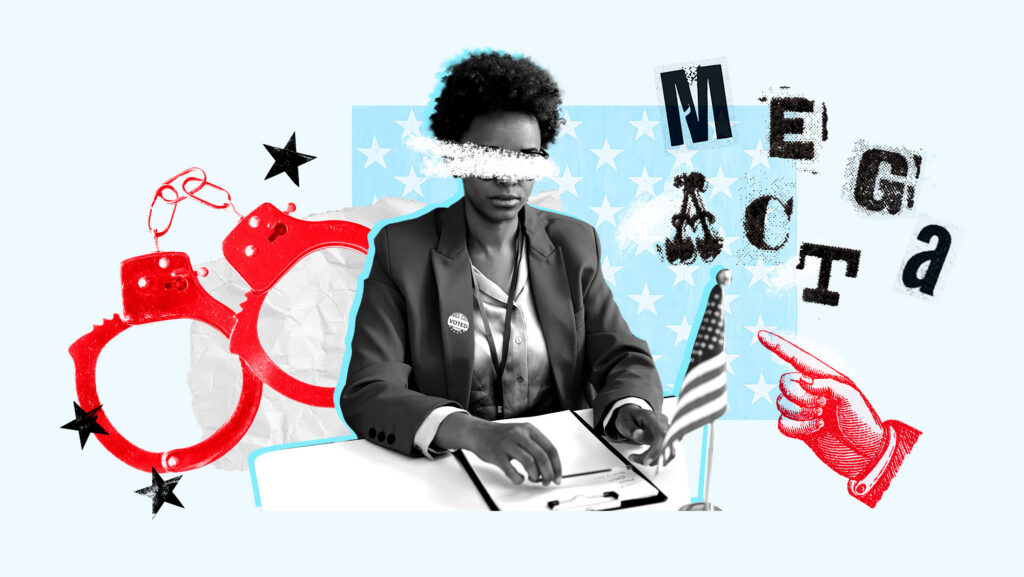
Republicans in Congress could steer voter registration drives into a ditch with bills that would all but prevent civic organizations like churches and grassroots community groups from collecting and submitting registration forms.
A pair of bills, if enacted, would make it harder for unregistered would-be voters, especially Black and Hispanic Americans, to get on the rolls.
The SAVE America Act, which the House passed earlier this month, would require citizens to provide documentary proof of citizenship (DPOC) — like a U.S. passport or a birth certificate — when they register, and to show government-issued photo identification when they vote. The proposal would also compel states to provide the federal government with access to their voter registration rolls and mandate monthly purges of those rolls.
The more comprehensive Make Elections Great Again (MEGA) Act would do all that and then some, including provisions to ban universal mail voting — in which all registered voters are mailed a ballot — and to prevent states from allowing grace periods for counting mail-in ballots that arrive after polls close.
Both measures would effectively ban, or significantly hinder, voter registration drives run by schools, colleges, unions, and other civic groups that aim to reach unregistered voters and get them on the rolls.
Get updates straight to your inbox — for free
Join 350,000 readers who rely on our daily and weekly newsletters for the latest in voting, elections and democracy.
SAVE would require an election official to check the registrant’s DPOC in person; even registrants using the national mail voter registration form would need to eventually show up in the flesh at an election office with the DPOC before they could vote. Since few people carry their passport or birth certificate around with them everyday like a wallet or cellphone, that would make voter registration drives — in which civic groups approach people in public places and offer them the chance to register — essentially impossible.
The MEGA Act would allow registrants to mail in a registration form with DPOC along with the last four digits of their social security number and another form of identification. But that bill, which has yet to come up for a vote, would also prevent federal funding from going to support voter registration or voter mobilization activities, like those run by churches.
While a local nonprofit or church that receives federal funds for other purposes — like running a women’s shelter or a charter school — should be able to continue registration drives using non-federal dollars, some groups may decide the risks are too high, said Frederick Vélez III Burgos, vice president for federal advocacy and network engagement at the Hispanic Federation.
Republican-led states have experimented in restricting third-party voter-registration organizations in recent years, according to Burgos.
“It’s coordinated,” said Burgos. “Florida, Texas and Arizona… they’re seen as places where you have a laboratory for cutting civil rights.”
Twenty-four states impose some restrictions on third-party voter registration, and two — Wyoming and New Hampshire — completely forbid it. The restrictions vary from requiring groups to register with the state or attend a training session, to more strict regulations, like bans on paying people to run registration drives. Many also require third parties to submit the registrations within certain time frames.
Texas has some of the most onerous restrictions on voter-registration groups. And, perhaps not coincidentally, it ranks 45th among states in percentage of population registered to vote. Attorney General Ken Paxton (R) has sued local governments for working with third parties to send voter applications to unregistered residents.
In Florida, Gov. Ron DeSantis (R) created a new election fraud office in 2022 that focused heavily on voter registration groups. A year later the legislature adopted new restrictions on the groups, including one forbidding noncitizens from working on voter registration drives.
The number of fines levied on these groups soon skyrocketed, with an apparent immediate impact on registration figures. Third-party registrations topped 63,000 Floridians in 2019 and 59,000 in 2020. In 2024, they dropped to under 22,000 voters and in 2024, just 1,905.
The Hispanic Federation successfully sued to block the citizenship requirement in 2024, but the other restrictions still apply. That, Burgos noted, imposes real legal liabilities on underfunded groups like his.
“These provisions and laws are being put in place to limit the ability of nonpartisan organizations like ours to register voters,” said Burgos.
“Vulnerable communities are three to four times more likely to get registered to vote by community-based organizations like ours, because they trust us,” Burgos added. “We’re not knocking on your door only to get you registered or get your vote. We have helped you with immigration services, we have helped you with health care. We have helped you with food insecurity. We have always been there so they trust us.”
Research backs that up. A 2022 study by Nonprofit VOTE found that young voters engaged by nonprofits were more likely to be Black or Hispanic, and compared to non-engaged minority voters, more likely to vote.
And a 2021 analysis by the Brennan Center for Justice found that “[p]ersons of color in Florida are five times more likely to rely on [third-party voter registration groups] when registering to vote than white individuals.”
The partisan implications are obvious — Black and Hispanic voters tend to support Democrats over Republicans.
The COVID pandemic also demonstrated the impact of third-party registrations — as states initiated shutdowns that prevented groups like the League of Women Voters from holding their drives, overall registration figures plummeted nationwide.
Comments (0)
No comments yet. Be the first to share your thoughts.
Sign in to leave a comment.