The Surprising Skill MAGA Christians Say Is 'Sinful' - HuffPost
The article discusses the rise of anti-empathy rhetoric among MAGA Christians, with influential voices framing empathy as a weakness, manipulation, or a threat to faith. This shift is seen as a deviation from Christian teachings of compassion and love, which are rooted in scripture and exemplified by Jesus Christ. Experts argue that vilifying empathy serves to reinforce existing power structures, justify bigotry, and disconnect believers from marginalized groups, ultimately undermining the core principles of Christianity.

If asked to name examples of sins, most people would probably not mention “empathy.” But in recent years, attacks on empathy have moved from fringe talking points into mainstream right-wing Christian discourse.
Conservative commentator Allie Beth Stuckey released a book in 2024 titled “Toxic Empathy.” The following year brought the release of “The Sin of Empathy” by right-wing theologian Joe Rigney. Shortly thereafter, billionaire Elon Musk declared on Joe Rogan’s podcast that “the fundamental weakness of Western civilization is empathy.”
Empathy is typically defined as the ability to understand and share the feelings and perspectives of other people. It’s a skill that many Christians have long seen as aligning with the teachings and example of Jesus Christ.
But proponents of the “toxic empathy” critique now argue that empathy can cloud moral judgment or be manipulated to advance policies they see as unbiblical. That shifting view on empathy in this era of “MAGA Christianity” concerns many religious scholars and advocates.
“In the last several years, especially within MAGA-aligned Christian spaces, I’ve watched empathy get rebranded as weakness,” said Malynda Hale, executive director of the Christian nonprofit The New Evangelicals. “In choosing to care about the lived experiences of others ― whether they are immigrants, LGBTQ people, Black communities, anyone outside the white evangelicals’ space and ideological lane ― people are framed as being ‘too emotional,’ ‘unbiblical,’ or even ‘compromising your faith.’”
The rise of Christian nationalism has seen empathy demonized as “sinful,” “dangerous,” “weak,” and even a tool of liberal manipulation. Calls for compassion toward marginalized groups are increasingly met with defensiveness or hostility.
With the popularity of books like those mentioned above “driving this blatant move away from Christ’s message of radical love, justice and preferential treatment of the oppressed, MAGA Christians are able to sit comfortably in their bigotry as their neighbors are kidnapped and murdered in the streets,” said Bible scholar Mattie Mae Motl.
“Christ-like empathy comes at a cost, and this is not a cost that MAGA Christians are willing to pay.”
- Bible scholar Mattie Mae Motl
Motl believes the vilification stems in part from the fact that empathy promotes a kind of compassion that cannot be controlled or commodified by profit-driven economic systems.
“I first noticed empathy specifically demonized during the 2024 election, but it’s just a repackaging of a phrase that was popular when I was a conservative Christian: ‘love the sinner, hate the sin.’ This phrase has also been weaponized to keep Christians from being too loving,” said April Ajoy, author of “Star-Spangled Jesus: Leaving Christian Nationalism and Finding A True Faith.”
She recalled learning this framework with regard to the LGBTQ+ community.
“It gives justification to Christian parents to abandon their queer kids without feeling guilty,” Ajoy said. “It also gives other Christians permission to bully LGBTQ people and work to take their rights away in the name of ‘tough love.’ But hate wrapped in piety is still hate.”
*The Role Of Empathy In Christianity *
In today’s political climate ― particularly amid horrifying news surrounding immigration enforcement ― critics say the anti-empathy rhetoric represents a sharp departure from Christianity’s New Testament foundation.
“Christianity is a faith built on compassion for the other,” Motl said. “It is the heart of Christ’s message. The greatest commandment, according to Jesus, is that we ‘love our neighbor as ourselves.’ Without empathy, we are only able to love the neighbor who looks, thinks and believes like us.”
She pointed to the parable of the Good Samaritan, in which Jesus demonstrates what neighborly love looks like using the example of a Samaritan.
“Samaritans were a people group historically despised and rejected among the Jewish communities that Jesus grew up in,” Motl said. “The message is clear: you are to love and fight for your neighbor, even when they look, think or believe differently than you.”
Scripture also describes Jesus as empathetic. Motl quoted Hebrews 4:15: “For we do not have a high priest who is unable to empathize with our weaknesses.”
“The Bible shows us that Christ’s work of salvation would be nothing without his divine and ultimate work of empathy,” she said. “This empathy was not neutral or passive. Instead, Christ’s empathy got him executed by the state ― not unlike Alex Pretti and Renee Nicole Good. Christ-like empathy comes at a cost, and this is not a cost that MAGA Christians are willing to pay.”
Ajoy sees the doctrine of the Incarnation as another reflection of Christianity as a “fundamentally empathetic theology.”
“In Jesus Christ, God enters into human vulnerability and suffering,” she said. “The Gospels repeatedly depict Jesus as emotionally responsive to the pain of others, most notably in John 11:35 ― ‘Jesus wept.’ Romans 12:15, which commands believers to ‘rejoice with those who rejoice, weep with those who weep,’ further underscores empathy as a normative Christian practice.”
She highlighted Jesus as a figure who stood with the outcast, not with the oppressors.
Hale recalls empathy being at the center of the Christian faith in which she was raised.
“I think specifically growing up in the Black church, that message of empathy was a core message because our understanding of Jesus’ words [was] to care for the marginalized and to understand the struggles of others,” she said. “That’s literally the foundation of what Jesus taught. And because so many outside factors in the United States affected the Black community differently, the church was always a place where you could go for that love and compassion.”
Why Empathy Has Been Demonized
“It’s so alarming to see so many MAGA Christians demonizing empathy today,” Ajoy said. “Empathy is frequently depicted as a moral liability that threatens political loyalty. If they can get their followers to believe it’s toxic to care about immigrant families being ripped apart, then it’s easier to continue cheering on the administration they claim came from God.”
She believes the far right Christian movement is targeting empathy as a defense mechanism.
“They have no excuse for supporting the inhumane treatment of our immigrant neighbors while claiming to follow a Christ who said, ‘I was a stranger and you did not welcome me ... and what you do to the least of these, you do to me,’” Ajoy explained. “So, they deflect instead.”
Calling empathy spiritually “dangerous” is a way to keep congregants tied to this MAGA Christian ideology.
“It trains regular churchgoers to keep their distance from those outside their small community,” Ajoy said. “If you never meet a trans person, it’s easier to believe all trans people are evil. Because it’s really hard to demonize someone when you’re close enough to see their humanity. And once the ‘other’ is humanized, a decent person would condemn their inhumane treatment. ‘Toxic empathy’ keeps well-meaning Christians from loving the neighbors Jesus called us to love.”
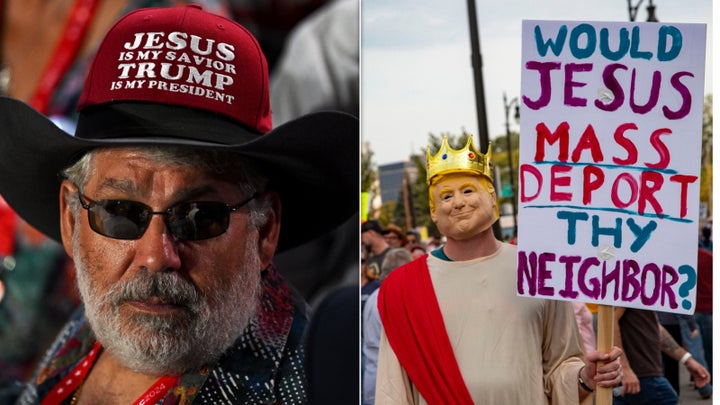
Hale echoed that white Christian nationalists generally cannot relate to the marginalized communities impacted by the current administration. So they feel more comfortable fearing and/or judging them.
“Because empathy requires you to see beyond your own experience, it forces you to acknowledge others have been hurt, reconsider your beliefs and sometimes confront the fact that your community has been on the wrong side of a lot of things,” she said. “That’s uncomfortable. And it’s also realizing that maybe they are clinging to the construct of whiteness and the protection it typically brings more than they are to a faith system.”
Empathy disrupts the MAGA movement’s clean narrative of hierarchy, identity and certainty. Rather than engage with discomfort or challenge certain beliefs and systems, it demonizes empathy.
“If a MAGA Christian witnesses something painful, like a child torn away from their parents, for example, or a woman bleeding out in a parking lot because of a change in abortive healthcare laws, they could be moved with compassion to soften their hard stance on ‘the rules’ according to the law,” said Tia Levings, a former Christian fundamentalist and author of “A Well-Trained Wife: My Escape from Christian Patriarchy.”
“They might vote differently, pay more attention to real outcomes or feel motivated to advocate for the weak or innocent,” she added.
People in power in extreme religions need rigid rules and static positions to maintain power and order, so they warn against the “danger” of compassion, flexibility and nuance.
“Framing empathy as a sin introduces shame and fear ― two powerful motivators and manipulations in high-control religion,” Levings said. “If a pastor or teacher can make someone afraid they’ll sin against God and go to a literal hell to burn for eternity if they allow themselves to be moved with compassion and take action to relieve someone’s pain, that person is more likely to put their blinders on and hope the pain isn’t happening.”
“As Trump’s administration continues to enact policies that are in direct conflict with Jesus’ teachings, MAGA Christians are left with a choice: Admit they were wrong or manipulate the narrative.”
- April Ajoy, author of “Star-Spangled Jesus: Leaving Christian Nationalism and Finding A True Faith”
Thus, branding empathy as toxic serves both an ideological function and an institutional one by protecting existing power structures.
“MAGA-aligned pastors and influencers have their livelihoods on the line,” Ajoy said. “If they admitted they were wrong about Trump or started condemning his administration, they’d lose their pulpits, platforms and community. These pastors told their congregants that Trump was God’s chosen, influencers told their followers Christians had to vote for him. And as Trump’s administration continues to enact policies that are in direct conflict with Jesus’ teachings, MAGA Christians are left with a choice: Admit they were wrong or manipulate the narrative.”
The changing views on empathy both reflect and stem from what Levings sees as a major theological shift in evangelical churches and seminaries from 2000 onward.
“Scripturally, it’s Jesus who fulfills compassion and empathy, moving the hard lines of Old Testament law to soften into the fruits of the spirit ― love, joy, peace, patience, goodness, gentleness, kindness, faithfulness and self-control,” she said. “But when churches and seminaries moved towards reformed theology and Calvinist doctrine, that came with a return to Old Testament law.”
She pointed to fundamentalists like Doug Wilson and John MacArthur, who were influential in shaping congregations to view empathy as weakness. It’s all part of theonomy ― the belief that Old Testament biblical law, including its judicial and penal codes, should be applied to modern society and civil government.
“Jesus is too liberal, too socialist, too forgiving,” Levings said. “Most importantly, Jesus’s compassion is at odds with the political power sought by the religious right. They prefer the ten commandments, harsh sentences, vanquishing so-called enemies and a militaristic stance in their culture war against science, progress and growth.”
The idea is that God is rigid and static. “Faith is holding a line, not feeling moved to comfort pain or see someone’s humanity,” Levings added.
What Happens When We Vilify Empathy
“Discouraging empathy leads to apathy, which leads to the approval of inhumane horrors,” Ajoy said. “Moral blindness is the direct result of discouraging empathy. We see this today in the unwavering loyalty MAGA Christians have extended to Trump, whose policies frequently stand in direct contradiction to the teachings of Jesus.”
Rather than stand with the marginalized, adherents of MAGA Christianity seem to have chosen to align with the powerful.
“As empathy is suppressed, emotional callousness is reframed as moral strength, and bigotry is reinterpreted as faithfulness,” Ajoy said. “Within Christian communities, condemning empathy distorts the character of God, severing divine justice from divine compassion. It also undermines the command to love our neighbor, where people become issues to solve instead of humans to love.”
Prioritizing self-interest and the interest of any specific political movement over compassion, love and decency risks us losing our humanity.
“Empathy is not optional in a faith that claims to be centered on love,” Hale said. “Love requires understanding and humility. Love requires stepping into someone else’s perspective, even when it’s uncomfortable. The more people choose to villainize empathy, the more risk losing the opportunity to live in a just compassionate world.”
That kind of loss is evident in today’s news headlines and the cognitive dissonance in how so many people respond to them.
“People are looking away and ignoring current events to avoid feeling moved,” Levings said. “They’re insisting they ‘aren’t political’ to avoid being engaged citizens. They’re ‘hardening their hearts,’ defiant and unfeeling. They’re reframing what it means to be called ‘Christian’ because their platform has so little to do with Jesus and what it means to follow Christ’s example.”
The real-world consequences are serious and even deadly at times.
“Sufferers can not count on the Christian community to relieve their suffering, because they’re obeying a dictator rather than living like Christ and seeking to relieve suffering,” Levings added. “Another consequence is that democracy is weakened, and our religious freedoms are stripped as we move into a Christian theocracy that has claimed to punish, suppress, legislate, imprison and vanquish those who don’t agree with them.”
Much of the anti-empathy rhetoric aims to control women. Levings observed that when federal immigration officers detained a preschooler and allegedly used him as “bait” to capture his family members, some of the most outraged and vocal critics were mothers.
“The Christian patriarchy views empathy and compassion as feminine weaknesses, and less masculine, making this part of the overall gender distinction they claim makes men and women different from one another,” Levings said. “Women as a voting bloc also endanger the patriarchy’s grip on political power. This press against empathy runs parallel to other attempts to marginalize women’s power, such as repealing the 19th Amendment, removing women from professional roles and programs and changing divorce laws so that we can’t leave marriages.”
Many of the theologians who spoke to HuffPost highlight the tenet that humans are made in God’s image and Christians are called to imitate Christ, who treated the poor, marginalized and oppressed with dignity and worth.
“Be wary of those flaunting their Christianity instead of living it out,” Ajoy said.
She pointed to the worship services at the White House, Oval Office prayer sessions and loud declarations that religion and Christianity are “back” as “showy demonstrations of faith without caring for the poor, the widow, the orphan, the immigrant, the single parent, etc.” As the Bible notes, “faith without works” is not true faith.
“These are an example of the religious hypocrites Jesus condemned in Matthew 15 ― ‘These people honor me with their lips but their hearts are far from me,’” Ajoy said. “It appears to me that if MAGA Christians lived in Bible times, they would say Jesus had toxic empathy when he healed people without health care, when he fed people who didn’t earn it or when he forgave and loved the adulterous woman instead of judging her. To have empathy is holy, not toxic.”
The original version of this story was published on HuffPost at an earlier date.
Comments (0)
No comments yet. Be the first to share your thoughts.
Sign in to leave a comment.